
RESEARCH PAPER
Synergistic Integration of AdaBoundL2 Optimization and DSCNN: A Novel Framework for Rolling Bearing Fault Diagnosis
1
North University of China, China
A – Conceptualization; B – Methodology; C – Software; D – Validation; E – Formal analysis; F – Investigation; G – Resources; H – Data curation; I – Writing – original draft; J – Writing – review & editing; K – Visualization; L – Supervision; M – Project administration; N – Funding acquisition
Submission date: 2026-02-06
Final revision date: 2026-09-04
Acceptance date: 2026-10-30
Online publication date: 2026-11-23
HIGHLIGHTS
- Proposes a novel framework combining AdaBoundL2 and SWDCNN for fault diagnosis
- AdaBoundL2 optimizer ensures high-accuracy diagnosis in strong noise environments
- The proposed architecture is built upon a depthwise separable neural network
- Surpasses traditional methods with macro-F1 score >98.69% under various conditions
KEYWORDS
fault diagnosisstructural optimizationdepthwise separable convolutionimproved regularized adaptive optimizer
TOPICS
ABSTRACT
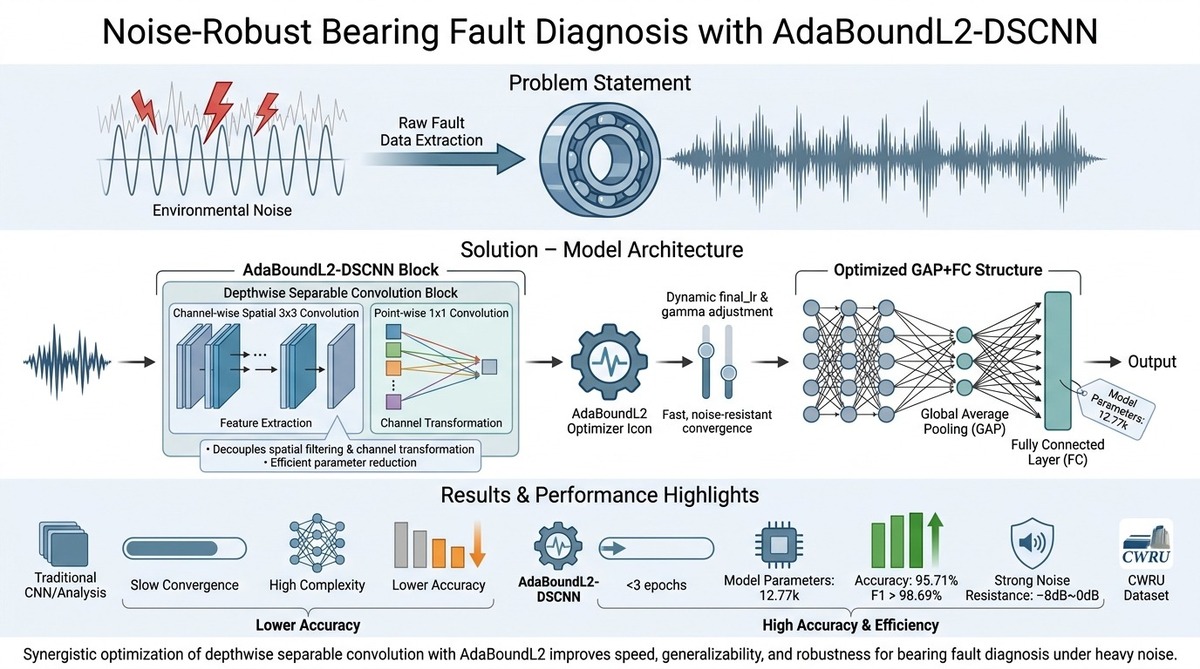
Environmental noise critically reduces bearing fault diagnosis accuracy and speed. While convolutional neural networks are extensively studied for this task, they often suffer from noise sensitivity and slow convergence. This paper proposes a method using a depthwise separable convolutional network optimized with AdaBoundL2. A custom regularized optimizer dynamically adjusts learning parameters to accelerate early-stage training and suppress noise. By replacing standard convolution with separate channelwise spatial and pointwise convolutions, the model decouples spatial filtering from channel transformation. This significantly reduces computation, accelerates convergence, and achieves over 99.9% accuracy within 3 epochs under strong noise. An optimized pooling and classification structure minimizes parameters to only 12.77k for improved generalization. Experiments demonstrate superior performance over conventional methods, with strong noise robustness and a macro F1-score exceeding 98.69%.
REFERENCES (37)
1.
Matania O, Dattner I, Bortman J, Kenett RS, Parmet Y. A systematic literature review of deep learning for vibration-based fault diagnosis of critical rotating machinery: Limitations and challenges. Journal of Sound and Vibration 2024; 590: 118562. doi:10.1016/j.jsv.2024.118562.
2.
Zhang H, Che W, Cao Y, Guan Z, Zhu C. Condition Monitoring and Fault Diagnosis of Rotating Machinery Towards Intelligent Manufacturing: Review and Prospect. Iranian Journal of Science and Technology, Transactions of Mechanical Engineering 2024; 49(1): 1-34. doi:10.1007/s40997-024-00783-w.
3.
Zhao K, Xiao J, Li C, Xu Z, Yue M. Fault diagnosis of rolling bearing using CNN and PCA fractal based feature extraction. Measurement 2023; 223: 113754. doi:10.1016/j.measurement.2023.113754.
4.
Mohammadi A, Westny T, Jung D, Krysander M. Analysis of Numerical Integration in RNN-Based Residuals for Fault Diagnosis of Dynamic Systems. IFAC-PapersOnLine 2023; 56(2): 2909-2914. doi:10.1016/j.ifacol.2023.10.1411.
5.
Yu JB. Evolutionary manifold regularized stacked denoising autoencoders for gearbox fault diagnosis. Knowledge-Based Systems 2019; 178: 111-122. doi:10.1016/j.knosys.2019.04.022.
6.
Li C, Mo L, Kwoh CK, Li X, Chen Z, Wu M, et al. Noise-robust multi-view graph neural network for fault diagnosis of rotating machinery. Mechanical Systems and Signal Processing 2025; 224: 112025. doi:10.1016/j.ymssp.2024.112025.
7.
Xie T, Huang X, Choi SK. Intelligent Mechanical Fault Diagnosis Using Multisensor Fusion and Convolution Neural Network. IEEE Transactions on Industrial Informatics 2022; 18(5): 3213-3223. doi:10.1109/tii.2021.3102017.
8.
Wang H, Liu Z, Peng D, Cheng Z. Attention-guided joint learning CNN with noise robustness for bearing fault diagnosis and vibration signal denoising. ISA Transactions 2022; 128: 470-484. doi:10.1016/j.isatra.2021.11.028.
9.
Shao Y. Denoising Noisy Neural Networks: A Bayesian Approach with Compensation_supp1-3290327.pdf. Institute of Electrical and Electronics Engineers (IEEE). doi:10.1109/tsp.2023.3290327/mm1.
10.
Lou S, Deng J, Lyu S. Chaotic signal denoising based on simplified convolutional denoising auto-encoder. Chaos, Solitons & Fractals 2022; 161: 112333. doi:10.1016/j.chaos.2022.112333.
11.
Zhong T, Cong Z, Wang H, Lu S, Dong X, Dong S, et al. Multiscale Encoder–Decoder Network for DAS Data Simultaneous Denoising and Reconstruction. IEEE Transactions on Geoscience and Remote Sensing 2023; 61: 1-15. doi:10.1109/tgrs.2023.3323527.
12.
Munishamaiaha K, Rajagopal G, Venkatesan DK, Arif M, Vicoveanu D, Chiuchisan I, et al. Robust Spatial–Spectral Squeeze–Excitation AdaBound Dense Network (SE-AB-Densenet) for Hyperspectral Image Classification. Sensors 2022; 22(9): 3229. doi:10.3390/s22093229.
13.
Liu X, Zhao T, Cao J, Li P. Design and prediction of self-organizing interval type-2 fuzzy wavelet neural network. Information Sciences 2024; 661: 120157. doi:10.1016/j.ins.2024.120157.
14.
Li W, Chiu PWY, Li Z. An Accelerated Finite-Time Convergent Neural Network for Visual Servoing of a Flexible Surgical Endoscope With Physical and RCM Constraints. IEEE Transactions on Neural Networks and Learning Systems 2020; 31(12): 5272-5284. doi:10.1109/tnnls.2020.2965553.
15.
Meni MJ, White RT, Mayo ML, Pilkiewicz KR. Entropy-based guidance of deep neural networks for accelerated convergence and improved performance. Information Sciences 2024; 681: 121239. doi:10.1016/j.ins.2024.121239.
16.
Islam MN, Shrestha R, Chowdhury SR. Energy-Efficient and High-Throughput CNN Inference Engine Based on Memory-Sharing and Data-Reusing for Edge Applications. IEEE Transactions on Circuits and Systems I: Regular Papers 2024; 71(7): 3189-3202. doi:10.1109/tcsi.2024.3392807.
17.
Papp L, Haberl D, Ecsedi B, Spielvogel CP, Krajnc D, Grahovac M, et al. DEBI-NN: Distance-encoding biomorphic-informational neural networks for minimizing the number of trainable parameters. Neural Networks 2023; 167: 517-532. doi:10.1016/j.neunet.2023.08.026.
18.
Romero Ugalde HM, Carmona JC, Alvarado VM, Reyes-Reyes J. Neural network design and model reduction approach for black box nonlinear system identification with reduced number of parameters. Neurocomputing 2013; 101: 170-180. doi:10.1016/j.neucom.2012.08.013.
19.
Chu SC, Dou ZC, Pan JS, Kong L, Snášel V, Watada J. DWSR: an architecture optimization framework for adaptive super-resolution neural networks based on meta-heuristics. Artificial Intelligence Review 2024; 57(2). doi:10.1007/s10462-023-10648-4.
20.
HU M, HE Y, LIN X, LU Z, JIANG Z, MA B. Digital twin model of gas turbine and its application in warning of performance fault. Chinese Journal of Aeronautics 2023; 36(3): 449-470. doi:10.1016/j.cja.2022.07.021.
21.
Lin H, Huang X, Chen Z, He G, Xi C, Li W. Matching Pursuit Network: An Interpretable Sparse Time-Frequency Representation Method Toward Mechanical Fault Diagnosis. IEEE Transactions on Neural Networks and Learning Systems 2025; 36(7): 12377-12388. doi:10.1109/tnnls.2024.3483954.
22.
Qi J, Chen Z, Kong Y, Qin W, Qin Y. Attention-guided graph isomorphism learning: A multi-task framework for fault diagnosis and remaining useful life prediction. Reliability Engineering & System Safety 2025; 263: 111209. doi:10.1016/j.ress.2025.111209.
23.
Zhi S, Niu Y, Ma L, Wu H, Shen H, Wang T. Local Entropy Selection Scaling-extracting Chirplet Transform for Enhanced Time-Frequency Analysis and Precise State Estimation in Reliability-Focused Fault Diagnosis of Non-stationary Signals. Eksploatacja i Niezawodność – Maintenance and Reliability 2026; 28(1): 205977. doi:10.17531/ein/205977.
24.
ZHANG J, KONG X, LI X, HU Z, CHENG L, YU M. Fault diagnosis of bearings based on deep separable convolutional neural network and spatial dropout. Chinese Journal of Aeronautics 2022; 35(10): 301-312. doi:10.1016/j.cja.2022.03.007.
25.
Jia X, Qin N, Huang D, Zhang Y, Du J. A clustered blueprint separable convolutional neural network with high precision for high-speed train bogie fault diagnosis. Neurocomputing 2022; 500: 422-433. doi:10.1016/j.neucom.2022.05.056.
26.
Guo Y, Zhou D, Chen H, Yue X, Cheng Y. Fault Intelligent Diagnosis for Distribution Box in Hot Rolling Based on Depthwise Separable Convolution and Bi-LSTM. Processes 2024; 12(9): 1999. doi:10.3390/pr12091999.
27.
Liu W, Zhang Z, Ye Z, He Q. A novel intelligent fault diagnosis method for gearbox based on multi-dimensional attention denoising convolution. Scientific Reports 2024; 14(1). doi:10.1038/s41598-024-75522-x.
28.
Li Z, Liu F, Yang W, Peng S, Zhou J. A Survey of Convolutional Neural Networks: Analysis, Applications, and Prospects. IEEE Transactions on Neural Networks and Learning Systems 2022; 33(12): 6999-7019. doi:10.1109/tnnls.2021.3084827.
29.
Saxena A, Goebel K. CWRU bearing data set. Case Western Reserve University. https://engineering.case.edu/b..., 2008 [accessed 20 November 2026].
30.
Gong W, Chen H, Zhang Z, Zhang M, Gao H. A Data-Driven-Based Fault Diagnosis Approach for Electrical Power DC-DC Inverter by Using Modified Convolutional Neural Network With Global Average Pooling and 2-D Feature Image. IEEE Access 2020; 8: 73677-73697. doi:10.1109/access.2020.2988323.
31.
Huang X, Xie T, Wu J, Zhou Q, Hu J. Deep continuous convolutional networks for fault diagnosis. Knowledge-Based Systems 2024; 292: 111623. doi:10.1016/j.knosys.2024.111623.
32.
Lee D, Jeong J. Few-Shot Learning-Based Light-Weight WDCNN Model for Bearing Fault Diagnosis in Siamese Network. Sensors 2023; 23(14): 6587. doi:10.3390/s23146587.
33.
Zhao J, Lu P, Du C, Cao F. Active Fault-Tolerant Strategy for Flight Vehicles: Transfer Learning-Based Fault Diagnosis and Fixed-Time Fault-Tolerant Control. IEEE Transactions on Aerospace and Electronic Systems 2024; 60(1): 1047-1059. doi:10.1109/taes.2023.3333763.
34.
Yan S, Shao H, Wang J, Zheng X, Liu B. LiConvFormer: A lightweight fault diagnosis framework using separable multiscale convolution and broadcast self-attention. Expert Systems with Applications 2024; 237: 121338. doi:10.1016/j.eswa.2023.121338.
35.
Edward, Ragab M, Wu M, Xu Y, Chen Z, Alseiari A, et al. EverAdapt: Continuous adaptation for dynamic machine fault diagnosis environments. Mechanical Systems and Signal Processing 2025; 226: 112317. doi:10.1016/j.ymssp.2025.112317.
36.
Li J, Wang N, Wang D, Gao G, Pan W. Lightweight neural networks with anti-colored noise for bearing fault diagnosis using deep separable convolution and transfer learning. Scientific Reports 2025; 15(1). doi:10.1038/s41598-025-28332-8.
37.
Suh S, Rey VF, Lukowicz P. TASKED: Transformer-based Adversarial learning for human activity recognition using wearable sensors via Self-KnowledgE Distillation. Knowledge-Based Systems 2023; 260: 110143. doi:10.1016/j.knosys.2022.110143.
Share
RELATED ARTICLE
| eISSN: | 2956-3860 |
| ISSN: | 1507-2711 |

We process personal data collected when visiting the website. The function of obtaining information about users and their behavior is carried out by voluntarily entered information in forms and saving cookies in end devices. Data, including cookies, are used to provide services, improve the user experience and to analyze the traffic in accordance with the Privacy policy. Data are also collected and processed by Google Analytics tool (more).
You can change cookies settings in your browser. Restricted use of cookies in the browser configuration may affect some functionalities of the website.