
RESEARCH PAPER
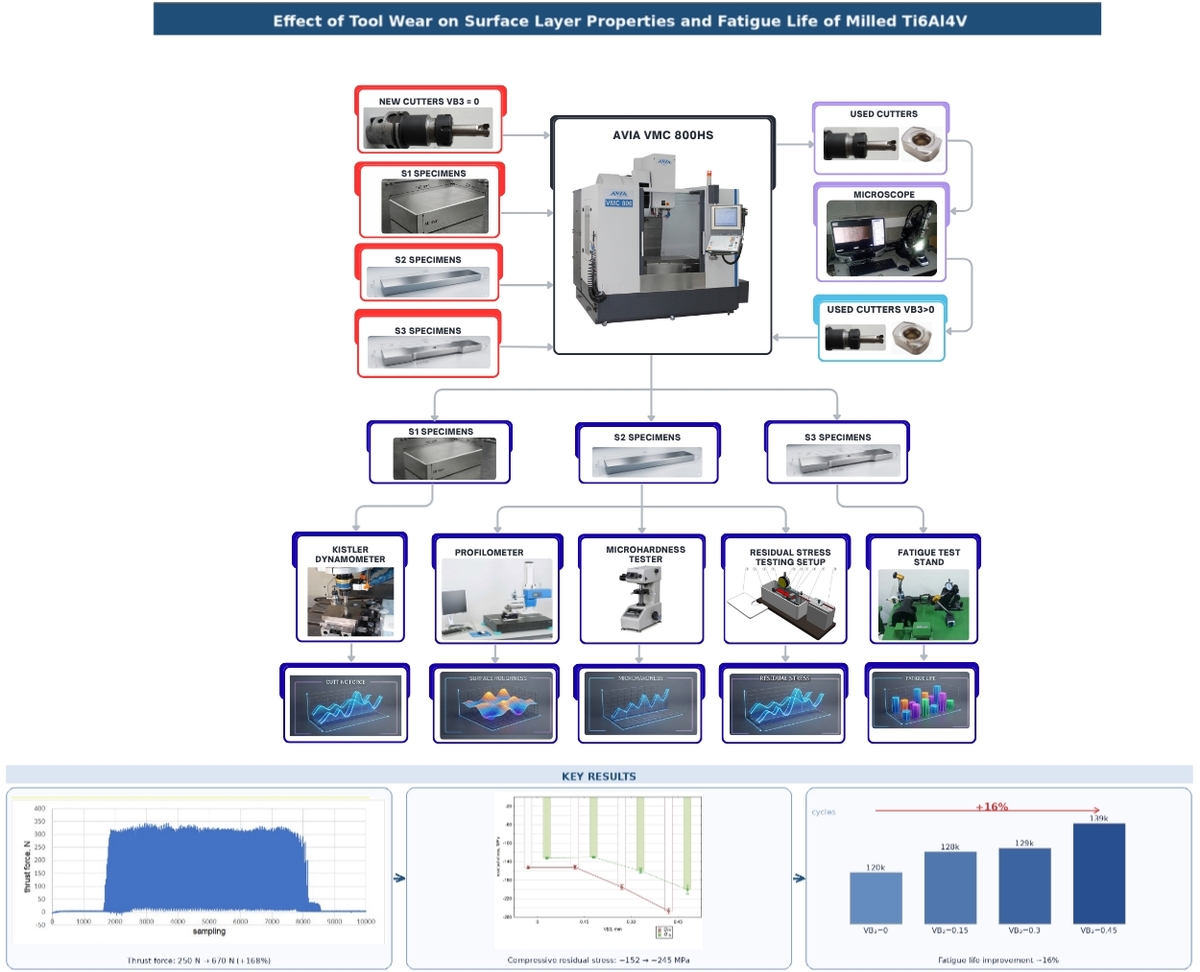
Effect of Tool Wear on the Surface Layer Properties and Fatigue Life of Milled Ti6Al4V Titanium Alloy Components

1
Lublin University of Technology, Poland
2
Department of Production Engineering, Lublin University of Technology, Poland
3
The Institute of Technical Sciences and Aviation, Państwowa Wyższa Szkoła Zawodowa w Chełmie, Poland
A – Conceptualization; B – Methodology; C – Software; D – Validation; E – Formal analysis; F – Investigation; G – Resources; H – Data curation; I – Writing – original draft; J – Writing – review & editing; K – Visualization; L – Supervision; M – Project administration; N – Funding acquisition
Submission date: 2026-05-06
Final revision date: 2026-08-03
Acceptance date: 2026-10-30
Online publication date: 2026-11-23
Corresponding author
HIGHLIGHTS
- • Flank wear of milling cutter affects surface layer properties of Ti6Al4V alloy
- • Progressive tool wear increases surface roughness from Sa = 0.75 to 0.90 µm
- • Compressive residual stresses increase in magnitude from −152 MPa to −245 MPa
- • Work hardening degree and hardening depth increase with progressive tool wear
- • Tool wear improves fatigue life by ~16% due to compressive residual stresses
KEYWORDS
TOPICS
ABSTRACT
Ti6Al4V titanium alloy is widely used in the aerospace, biomedical, and chemical industries due to its excellent mechanical properties and corrosion resistance. This study investigates the effect of milling cutter flank wear (VB3 = 0–0.45 mm) on the surface layer properties and fatigue life of Ti6Al4V titanium alloy specimens. Progressive tool wear caused a slight increase in surface roughness (Sa increased from 0.75 µm to 0.90 µm). Compressive residual stresses increased from −152 MPa to −245 MPa, with their depth rising from 40 µm to 128 µm. The degree of work hardening increased from 5.5% to 8.6%, and the hardening depth rose from 20 µm to 29 µm. The results reveal a competition between the detrimental effect of increased surface roughness and the beneficial effect of compressive residual stresses on fatigue performance, with the latter proving dominant: despite increased roughness, fatigue life improved by approximately 16%. The results demonstrate that milling conducted with the conditions applied in the study can be recommended as a finishing operation for Ti6Al4V components.
REFERENCES (62)
1.
Grochalski K, Jabłoński P, Talar R, Twardowski P, Wieczorowski M, Jakubek B, Rukat W. Temperature Measurement of Modern Cutting Tools During Turning. Advances in Science and Technology Research Journal 2020; 14(4): 37-48. https://doi.org/10.12913/22998....
2.
Shan C, Zhang X, Shen B, Zhang D. An improved analytical model of cutting temperature in orthogonal cutting of Ti6Al4V. Chinese Journal of Aeronautics 2019; 32(3): 759-69. https://doi.org/10.1016/j.cja.....
3.
Bandapalli C, Sutaria BM, Prasad Bhatt DV, Singh KK. Tool Wear Analysis of Micro End Mills - Uncoated and PVD Coated TiAlN & AlTiN in High Speed Micro Milling of Titanium Alloy - Ti-0.3Mo-0.8Ni. Procedia CIRP 2018; 77: 626-9. https://doi.org/10.1016/j.proc....
4.
Ciecieląg K. Analysis of the Surface Layer and Feed Force after Milling Polymer Composites with Coated and Uncoated Tools. Advances in Science and Technology Research Journal 2023; 17(4): 70-8. https://doi.org/10.12913/22998....
5.
Gerhard N, Brans K, Meurer M, Schraknepper D, Bergs T. Experimental investigation of the friction behavior under cutting conditions. Procedia CIRP 2023; 118: 437-42. https://doi.org/10.1016/j.proc....
6.
Zawada-Michałowska M, Pieśko P, Józwik J. Tribological Aspects of Cutting Tool Wear during the Turning of Stainless Steels. Materials 2019; 13(1): 123. https://doi.org/10.3390/ma1301....
7.
Twardowski P, Legutko S, Krolczyk GM, Hloch S. Investigation of wear and tool life of coated carbide and cubic boron nitride cutting tools in high speed milling. Advances in Mechanical Engineering 2015; 7(6). https://doi.org/10.1177/168781....
8.
Qiu J, Zhang S, Li B, Li Y, Wang L. Research on Tool Wear and Surface Integrity of CFRPs with Mild Milling Parameters. Coatings 2023; 13(1): 207. https://doi.org/10.3390/coatin....
9.
Zhuang K, Zou L, Weng J, Hu C. Occurrence of catastrophic tool wear patterns through systematic thermomechanical modeling. Journal of Manufacturing Processes 2024; 109: 288-99. https://doi.org/10.1016/j.jmap....
10.
Kumar Wagri N, Petare A, Agrawal A, Rai R, Malviya R, Dohare S, Kishore K. An overview of the machinability of alloy steel. Materials Today: Proceedings 2022; 62: 3771-81. https://doi.org/10.1016/j.matp....
11.
Zhao Z, To S, Wang J, Zhang G, Weng Z. A review of micro/nanostructure effects on the machining of metallic materials. Materials & Design 2022; 224: 111315. https://doi.org/10.1016/j.matd....
12.
Klocke F, Krämer A, Sangermann H, Lung D. Thermo-Mechanical Tool Load during High Performance Cutting of Hard-to-Cut Materials. Procedia CIRP 2012; 1: 295-300. https://doi.org/10.1016/j.proc....
13.
Abdel-Aal HA, Nouari M, El Mansori M. Influence of thermal conductivity on wear when machining titanium alloys. Tribology International 2009; 42(2): 359-72. https://doi.org/10.1016/j.trib....
14.
Alabort E, Tang YT, Barba D, Reed RC. Alloys-by-design: A low-modulus titanium alloy for additively manufactured biomedical implants. Acta Materialia 2022; 229: 117749. https://doi.org/10.1016/j.acta....
15.
Li R, Shih AJ. Tool Temperature in Titanium Drilling. Journal of Manufacturing Science and Engineering 2007; 129(4): 740-9. https://doi.org/10.1115/1.2738....
16.
Arrazola PJ, Garay A, Iriarte LM, Armendia M, Marya S, Le Maître F. Machinability of titanium alloys (Ti6Al4V and Ti555.3). Journal of Materials Processing Technology 2009; 209(5): 2223-30. https://doi.org/10.1016/j.jmat....
17.
Su H, Liu P, Fu Y, Xu J. Tool Life and Surface Integrity in High-speed Milling of Titanium Alloy TA15 with PCD/PCBN Tools. Chinese Journal of Aeronautics 2012; 25(5): 784-90. https://doi.org/10.1016/S1000-....
18.
Kuczmaszewski J, Zaleski K, Matuszak J, Pałka T, Mądry J. Studies on the effect of mill microstructure upon tool life during slot milling of Ti6Al4V alloy parts. Eksploatacja i Niezawodnosc – Maintenance and Reliability 2017; 19(4): 590-6. https://doi.org/10.17531/ein.2....
19.
Lebaal N, Nouari M, Ginting A. A new optimization approach based on Kriging interpolation and sequential quadratic programming algorithm for end milling refractory titanium alloys. Applied Soft Computing 2011; 11(8): 5110-9. https://doi.org/10.1016/j.asoc....
20.
Liu E, Wang R, Zhang Y, An W. Tool wear analysis of cutting Ti-5553 with uncoated carbide tool under liquid nitrogen cooling condition using tool wear maps. Journal of Manufacturing Processes 2021; 68: 877-87. https://doi.org/10.1016/j.jmap....
21.
Gupta MK, Niesłony P, Sarikaya M, Korkmaz ME, Kuntoğlu M, Królczyk GM, Jamil M. Tool wear patterns and their promoting mechanisms in hybrid cooling assisted machining of titanium Ti-3Al-2.5V/grade 9 alloy. Tribology International 2022; 174: 107773. https://doi.org/10.1016/j.trib....
22.
Gaddam R, Pittala GM, Yussefian NZ, Jamal M, See TL. Study of new solid end mill for side milling of Ti-6Al-4V with improved cooling efficiency. Procedia CIRP 2021; 101: 282-5. https://doi.org/10.1016/j.proc....
23.
Da Silva RB, Machado ÁR, Ezugwu EO, Bonney J, Sales WF. Tool life and wear mechanisms in high speed machining of Ti–6Al–4V alloy with PCD tools under various coolant pressures. Journal of Materials Processing Technology 2013; 213(8): 1459-64. https://doi.org/10.1016/j.jmat....
24.
Sultana MN, Dhar NR. Performance evaluation of high-pressure cooling by using external rotary liquid applicator in milling Ti–6Al–4V alloy. Heliyon 2023; 9(7): e17671. https://doi.org/10.1016/j.heli....
25.
Li M, Yue C, Liu X, Zang W, Jiang Z. Diffusion between Ti6Al4V and Cemented Carbide with Different Compositions. Metals 2023; 13(2): 240. https://doi.org/10.3390/met130....
26.
Nouari M, Ginting A. Wear characteristics and performance of multi-layer CVD-coated alloyed carbide tool in dry end milling of titanium alloy. Surface and Coatings Technology 2006; 200(18-19): 5663-76. https://doi.org/10.1016/j.surf....
27.
Kim G, Yang SM, Kim DM, Kim S, Choi JG, Ku M, Lim S, Park H. Bayesian-based uncertainty-aware tool-wear prediction model in end-milling process of titanium alloy. Applied Soft Computing 2023; 148: 110922. https://doi.org/10.1016/j.asoc....
28.
Zanger F, Schulze V. Investigations on Mechanisms of Tool Wear in Machining of Ti-6Al-4V Using FEM Simulation. Procedia CIRP 2013; 8: 158-63. https://doi.org/10.1016/j.proc....
29.
Lindvall R, Lenrick F, Persson H, M’Saoubi R, Ståhl JE, Bushlya V. Performance and wear mechanisms of PCD and pcBN cutting tools during machining titanium alloy Ti6Al4V. Wear 2020; 454-455: 203329. https://doi.org/10.1016/j.wear....
30.
Zareena AR, Veldhuis SC. Tool wear mechanisms and tool life enhancement in ultra-precision machining of titanium. Journal of Materials Processing Technology 2012; 212(3): 560-70. https://doi.org/10.1016/j.jmat....
31.
Wang Y, Zou B, Huang C. Tool wear mechanisms and micro-channels quality in micro-machining of Ti-6Al-4V alloy using the Ti(C7N3)-based cermet micro-mills. Tribology International 2019; 134: 60-76. https://doi.org/10.1016/j.trib....
32.
Tan DW, Guo WM, Wang HJ, Lin HT, Wang CY. Cutting performance and wear mechanism of TiB2-B4C ceramic cutting tools in high speed turning of Ti6Al4V alloy. Ceramics International 2018; 44(13): 15495-502. https://doi.org/10.1016/j.cera....
33.
Ma J, Luo D, Liao X, Zhang Z, Huang Y, Lu J. Tool wear mechanism and prediction in milling TC18 titanium alloy using deep learning. Measurement 2021; 173: 108554. https://doi.org/10.1016/j.meas....
34.
Zhao W, Wang S, Han Z, He N. Cutting Performance Evaluation of End Mills for Titanium Aircraft Components. Procedia CIRP 2015; 35: 1-7. https://doi.org/10.1016/j.proc....
35.
Tlhabadira I, Daniyan I, Masu L, Mpofu K. Computer aided modelling and experimental validation for effective milling operation of titanium alloy (Ti6Al4V). Procedia CIRP 2020; 91: 113-20. https://doi.org/10.1016/j.proc....
36.
Rudawska A, Reszka M, Warda T, Miturska I, Szabelski J, Stančeková D, Skoczylas A. Milling as a method of surface pre-treatment of steel for adhesive bonding. Journal of Adhesion Science and Technology 2016; 30(23): 2619-36. https://doi.org/10.1080/016942....
37.
Daniyan I, Tlhabadira I, Mpofu K, Adeodu A. Investigating the geometrical effects of cutting tool on the surface roughness of titanium alloy (Ti6Al4V) during milling operation. Procedia CIRP 2021; 99: 157-64. https://doi.org/10.1016/j.proc....
38.
Polishetty A, Shunmugavel M, Goldberg M, Littlefair G, Singh RK. Cutting Force and Surface Finish Analysis of Machining Additive Manufactured Titanium Alloy Ti-6Al-4V. Procedia Manufacturing 2017; 7: 284-9. https://doi.org/10.1016/j.prom....
39.
Kishore Kumar MS, Gurudatt B, Reddappa HN, Suresh R. Investigations on the effect of Machining parameters on Machining force and roughness in Micro-Milling of Titanium Gr5 and Gr12 alloys under dry Machining conditions using carbide tool. Materials Today: Proceedings 2021; 47: 2598-602. https://doi.org/10.1016/j.matp....
40.
Wu X, Chen Z, Ke W, Jiang F, Zhao M, Li L, Shen J, Zhu L. Investigation on surface quality in micro milling of additive manufactured Ti6Al4V titanium alloy. Journal of Manufacturing Processes 2023; 101: 446-57. https://doi.org/10.1016/j.jmap....
41.
Lotfi M, Charkhian A, Akbari J. Surface analysis in rotary ultrasonic-assisted milling of CFRP and titanium. Journal of Manufacturing Processes 2022; 84: 174-82. https://doi.org/10.1016/j.jmap....
42.
Ali MH. Studied validation of finite element modeling for titanium alloy (Ti–6Al–4V) at face milling. Heliyon 2023; 9(7): e17670. https://doi.org/10.1016/j.heli....
43.
Mersni W, Boujelbene M, Ben Salem S, Singh HP. Machining time and quadratic mean roughness optimization in ball end milling of titanium alloy Ti-6Al-4V – Aeronautic field. Materials Today: Proceedings 2020; 26: 2619-24. https://doi.org/10.1016/j.matp....
44.
Sur G, Motorcu AR, Nohutçu S. Single and multi-objective optimization for cutting force and surface roughness in peripheral milling of Ti6Al4V using fixed and variable helix angle tools. Journal of Manufacturing Processes 2022; 80: 529-45. https://doi.org/10.1016/j.jmap....
45.
Polishetty A, Goldberg M, Littlefair G, Puttaraju M, Patil P, Kalra A. A Preliminary Assessment of Machinability of Titanium Alloy Ti 6AL 4V During thin Wall Machining Using Trochoidal Milling. Procedia Engineering 2014; 97: 357-64. https://doi.org/10.1016/j.proe....
46.
Kuczmaszewski J, Zaleski K, Matuszak J, Mądry J. Testing Geometric Precision and Surface Roughness of Titanium Alloy Thin-Walled Elements Processed with Milling. In: Diering M, Wieczorowski M, Brown CA, editors. Advances in Manufacturing II. Cham: Springer International Publishing; 2019. p. 95-106. https://doi.org/10.1007/978-3-....
47.
Sun C, Shen X, Wang W. Study on the Milling Stability of Titanium Alloy Thin-walled Parts Considering the Stiffness Characteristics of Tool and Workpiece. Procedia CIRP 2016; 56: 580-4. https://doi.org/10.1016/j.proc....
48.
Delport LD, Conradie PJT, Oosthuizen GA. Suitable Clamping Method for Milling of Thin-walled Ti6Al4V Components. Procedia Manufacturing 2017; 8: 338-44. https://doi.org/10.1016/j.prom....
49.
Kurpiel S, Zagórski K, Cieślik J, Skrzypkowski K, Kapayeva S, Torekhanova M. Dimensional Deviations of Horizontal Thin Wall of Titanium Alloy Ti6Al4V Determined by Optical and Contact Methods. Materials 2023; 16(23): 7272. https://doi.org/10.3390/ma1623....
50.
Stupnytskyy V, Hrytsay I. Comprehensive analysis of the product’s operational properties formation considering machining technology. Archive of Mechanical Engineering 2020; 67(2): 149-167. https://doi.org/10.24425/ame.2....
51.
Żebrowski R, Walczak M, Klepka T, Pasierbiewicz K. Effect of the shot peening on surface properties of Ti-6Al-4V alloy produced by means of DMLS technology. Eksploatacja i Niezawodność – Maintenance and Reliability 2019; 21(1): 46-53. https://doi.org/10.17531/ein.2....
52.
Chen C, Feng T, Zhang Y, Ren B, Hao Wang, Zhao X. Improvement of microstructure and mechanical properties of TC4 titanium alloy GTAW based wire arc additive manufacturing by using interpass milling. Journal of Materials Research and Technology 2023; 27: 1428-45. https://doi.org/10.1016/j.jmrt....
53.
Shokrani A, Dhokia V, Newman ST. Investigation of the effects of cryogenic machining on surface integrity in CNC end milling of Ti–6Al–4V titanium alloy. Journal of Manufacturing Processes 2016; 21: 172-9. https://doi.org/10.1016/j.jmap....
54.
Khosravi J, Azarhoushang B, Barmouz M, Bösinger R, Zahedi A. High-speed milling of Ti6Al4V under a supercritical CO2 + MQL hybrid cooling system. Journal of Manufacturing Processes 2022; 82: 1-14. https://doi.org/10.1016/j.jmap....
55.
Yang P, Yao C, Xie S, Zhang D, Tang DX. Effect of Tool Orientation on Surface Integrity During Ball End Milling of Titanium Alloy TC17. Procedia CIRP 2016; 56: 143-8. https://doi.org/10.1016/j.proc....
56.
Houchuan Y, Zhitong C, ZiTong Z. Influence of cutting speed and tool wear on the surface integrity of the titanium alloy Ti-1023 during milling. The International Journal of Advanced Manufacturing Technology 2015; 78(5-8): 1113-26. https://doi.org/10.1007/s00170....
57.
Wimmer M, Woelfle CH, Krempaszky C, Zaeh MF. The influences of process parameters on the thermo-mechanical workpiece load and the sub-surface residual stresses during peripheral milling of Ti-6Al-4V. Procedia CIRP 2021; 102: 471-6. https://doi.org/10.1016/j.proc....
58.
Köhler J, Grove T, Maiß O, Denkena B. Residual Stresses in Milled Titanium Parts. Procedia CIRP 2012; 2: 79-82. https://doi.org/10.1016/j.proc....
59.
Robles A, Aurrekoetxea M, Plaza S, Llanos I, Zelaieta O. Empirical modeling of residual stress profiles in Ti6Al4V after face-milling. Procedia CIRP 2022; 108: 362-6. https://doi.org/10.1016/j.proc....
60.
Childerhouse T, M’Saoubi R, Franca L, Weston N, Crawforth P, Jackson M. The influence of machining induced surface integrity and residual stress on the fatigue performance of Ti-6Al-4V following polycrystalline diamond and coated cemented carbide milling. International Journal of Fatigue 2022; 163: 107054. https://doi.org/10.1016/j.ijfa....
61.
Yang D, Liu Z, Xiao X, Xie F. The Effects of Machining-induced Surface Topography on Fatigue Performance of Titanium Alloy Ti-6Al-4V. Procedia CIRP 2018; 71: 27-30. https://doi.org/10.1016/j.proc....
62.
Matuszak J, Zaleski K, Zyśko A. Investigation of the Impact of High-Speed Machining in the Milling Process of Titanium Alloy on Tool Wear, Surface Layer Properties, and Fatigue Life of the Machined Object. Materials 2023; 16(15): 5361. https://doi.org/10.3390/ma1615....
Share
RELATED ARTICLE
| eISSN: | 2956-3860 |
| ISSN: | 1507-2711 |

We process personal data collected when visiting the website. The function of obtaining information about users and their behavior is carried out by voluntarily entered information in forms and saving cookies in end devices. Data, including cookies, are used to provide services, improve the user experience and to analyze the traffic in accordance with the Privacy policy. Data are also collected and processed by Google Analytics tool (more).
You can change cookies settings in your browser. Restricted use of cookies in the browser configuration may affect some functionalities of the website.