
RESEARCH PAPER
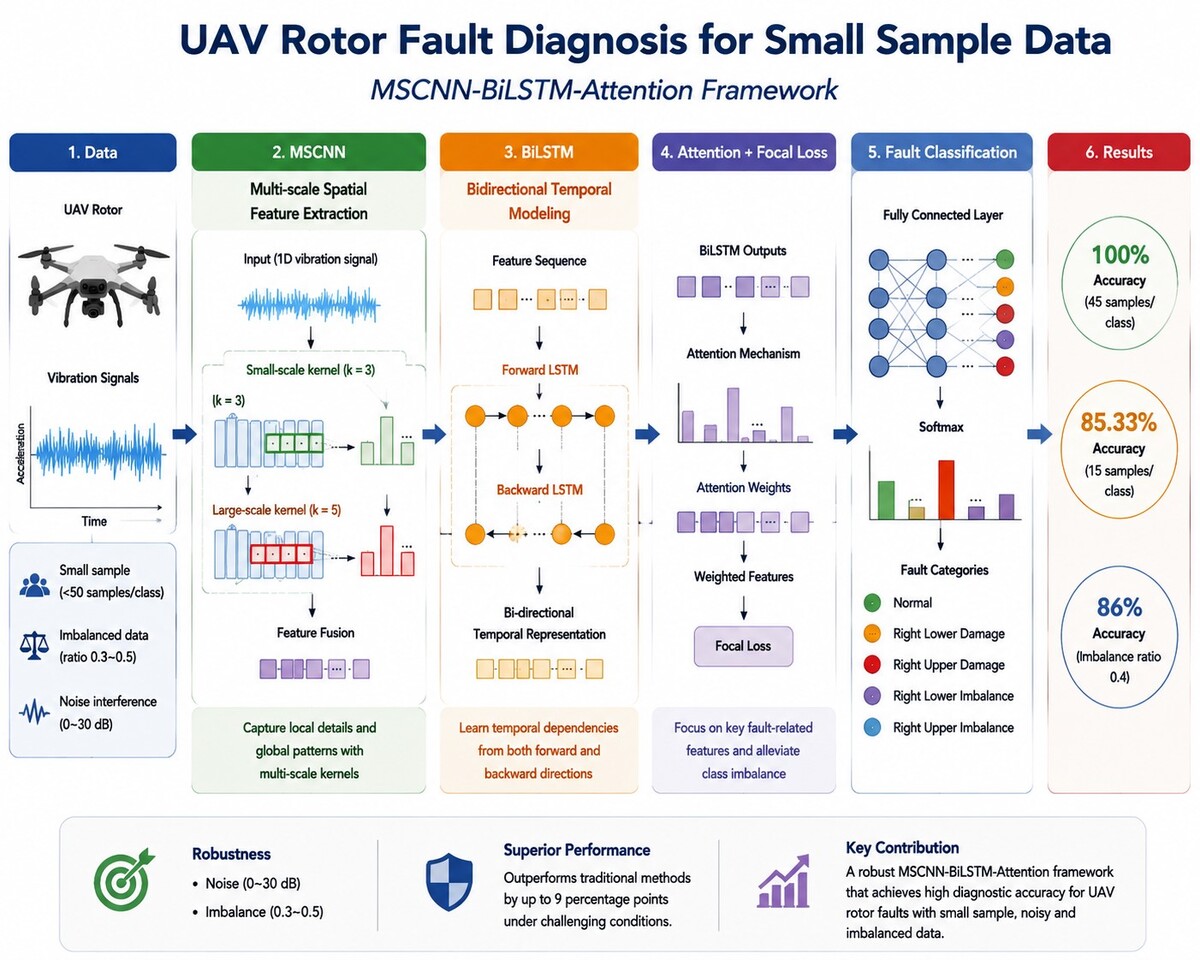
Research on UAV Rotor Fault Diagnosis for Small Sample Data
1
College of Electrical Engineering, Zhejiang University, China
A – Conceptualization; B – Methodology; C – Software; D – Validation; E – Formal analysis; F – Investigation; G – Resources; H – Data curation; I – Writing – original draft; J – Writing – review & editing; K – Visualization; L – Supervision; M – Project administration; N – Funding acquisition
Submission date: 2025-11-07
Final revision date: 2026-04-03
Acceptance date: 2026-06-25
Online publication date: 2026-08-07
Publication date: 2026-08-13
Eksploatacja i Niezawodność – Maintenance and Reliability 2027;29(1):225080
KEYWORDS
attention mechanismimbalanced databidirectional long short-term memory networkUAV rotor fault diagnosissmall sample learningmulti-scale convolutional neural network
TOPICS
ABSTRACT
Unmanned Aerial Vehicles (UAVs) face significant challenges in rotor fault diagnosis under small-sample and imbalanced data conditions, which severely limit the effectiveness of existing data-driven methods. In practical applications, fault samples are often fewer than 50 per class, with imbalance ratios typically 0.3–0.5, under which conventional deep learning approaches exhibit notable performance degradation. To address these issues, this paper proposes an MSCNN-BiLSTM-Attention framework for UAV rotor fault diagnosis. The method integrates multi-scale convolution to enhance spatial feature extraction from limited vibration data, bidirectional LSTM to capture temporal dependencies, and an attention mechanism combined with Focal Loss to improve minority-class learning. Experiments demonstrate that the proposed framework consistently outperforms conventional methods under small-sample, noisy, and imbalanced conditions, achieving a maximum improvement of up to 9 percentage points, which confirms its robustness and effectiveness in challenging diagnostic scenarios.
Share
RELATED ARTICLE
| eISSN: | 2956-3860 |
| ISSN: | 1507-2711 |

We process personal data collected when visiting the website. The function of obtaining information about users and their behavior is carried out by voluntarily entered information in forms and saving cookies in end devices. Data, including cookies, are used to provide services, improve the user experience and to analyze the traffic in accordance with the Privacy policy. Data are also collected and processed by Google Analytics tool (more).
You can change cookies settings in your browser. Restricted use of cookies in the browser configuration may affect some functionalities of the website.
You can change cookies settings in your browser. Restricted use of cookies in the browser configuration may affect some functionalities of the website.