
RESEARCH PAPER
A method for predictive maintenance of freight wagons taking into account reliability indicators and the risk of loss of serviceability

1
Department of Rail Vehicles and Transport, PK Krakow University of Technology, Poland
A – Conceptualization; B – Methodology; C – Software; D – Validation; E – Formal analysis; F – Investigation; G – Resources; H – Data curation; I – Writing – original draft; J – Writing – review & editing; K – Visualization; L – Supervision; M – Project administration; N – Funding acquisition
Submission date: 2026-07-24
Final revision date: 2026-09-06
Acceptance date: 2026-10-30
Online publication date: 2026-11-20
Corresponding author
Maciej Grzywna
Department of Rail Vehicles and Transport, PK Krakow University of Technology, Jana Pawla II, 31-864, Krakow, Poland
Department of Rail Vehicles and Transport, PK Krakow University of Technology, Jana Pawla II, 31-864, Krakow, Poland
HIGHLIGHTS
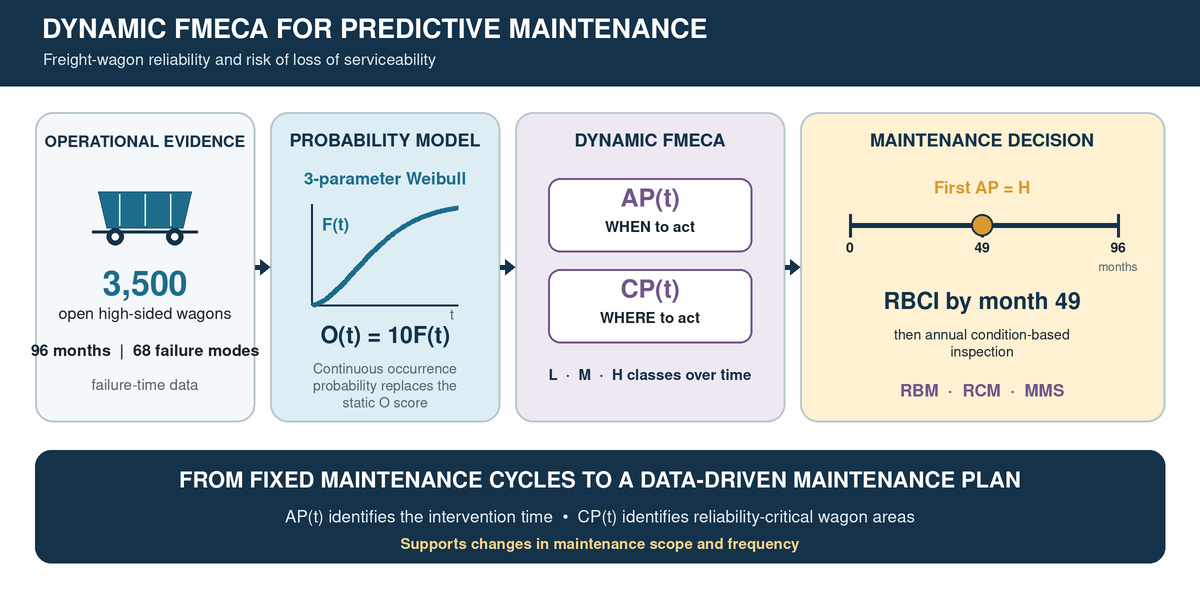
- Dynamic FMECA links failure probability with freight wagon maintenance timing
- The method replaces the static occurrence score with a continuous F(t) function
- AP(t) indicates when to act, while CP(t) identifies critical wagon areas
- The method was validated using 3,500 wagons observed over 96 months
- Results support predictive maintenance strategies aligned with RBM and RCM
KEYWORDS
TOPICS
ABSTRACT
The article presents a method for predictive maintenance of freight wagons that integrates operational failure data with a probabilistic description of the failure-occurrence process of classical FMECA. The method involves replacing selected coefficients with a continuous function of the cumulative distribution function F(t) and introduces dynamic risk-mitigation priority indices AP(t) and dynamic criticality classes CP(t). These findings can serve as a basis for modifying the scope and frequency of maintenance activities, supporting the transition from a maintenance strategy based solely on cycles to a predictive maintenance strategy aligned with the principles of RBM (Risk-Based Maint.) and RCM (Reliability-Centered Maint.). The application of the method was demonstrated using operational data collected from a sample of 3,500 freight wagons over 96 months. The results obtained indicate that the method makes it possible to determine the point in time at which additional maintenance actions should be taken and also serves as a basis for defining additional corrective actions.
REFERENCES (25)
1.
Dinmohammadi F, Alkali B, Shafiee M, Bérenguer C, Labib A. Risk evaluation of railway rolling stock failures using FMECA technique: a case study of passenger door system. Urban Rail Transit 2016; 2(3-4): 128-145. doi:10.1007/s40864-016-0043-z.
2.
Dinmohammadi F. A risk-based modelling approach to maintenance optimization of railway rolling stock: a case study of pantograph system. Journal of Quality in Maintenance Engineering 2019; 25(2):272-293. doi:10.1108/JQME-11-2016-0070.
3.
Appoh F, Yunusa-Kaltungo A, Sinha JK, Kidd M. Practical demonstration of a hybrid model for optimising the reliability, risk, and maintenance of rolling stock subsystem. Urban Rail Transit 2021; 7(2): 139-157. doi:10.1007/s40864-021-00148-5.
4.
Wang W, Wang Y, Han X. A dynamic failure mode and effects analysis for train systems failures risk assessment using FCM and prospect theory. Management System Engineering 2022; 1(1): 8. doi:10.1007/s44176-022-00008-x.
5.
Catelani M, Ciani L, Galar D, Guidi G, Matucci S, Patrizi G. FMECA assessment for railway safety-critical systems investigating a new risk threshold method. IEEE Access 2021; 9: 86243-86253. doi:10.1109/ACCESS.2021.3088948.
6.
Seyedan Oskouei SF, Abapour M, Beiraghi M. Identifying critical components for railways rolling stock reliability: a case study for Iran. Scientific Reports 2024; 14(1): 12080. doi:10.1038/s41598-024-62841-2.
7.
Polish Committee for Standardization. PN-EN IEC 60812: Failure modes and effects analysis (FMEA and FMECA). Warsaw: Polish Committee for Standardization; 2018.
8.
Szkoda M, Kaczor G, Grzywna M. A method for assessing the criticality of failures of railway vehicle components using the FMECA method. Transport Problems 2024; 19(3): 93-106. doi:10.20858/tp.2023.19.3.08.
9.
Act of 28 March 2003 on rail transport. Journal of Laws of 2024, item 697 [in Polish].
10.
Regulation of the Minister of Infrastructure of 12 October 2005 on the general technical conditions for the operation of railway vehicles. Journal of Laws of 2016, item 226, as amended [in Polish].
11.
European Commission. Commission Implementing Regulation (EU) 2019/779 of 16 May 2019 laying down detailed provisions on a system of certification of entities in charge of maintenance of vehicles pursuant to Directive (EU) 2016/798 of the European Parliament and of the Council and repealing Commission Regulation (EU) No 445/2011. Official Journal of the European Union 2019; L139I: 360-389.
12.
European Parliament and Council of the European Union. Directive (EU) 2016/798 of 11 May 2016 on railway safety. Official Journal of the European Union 2016; L138: 102-149.
13.
European Parliament and Council of the European Union. Directive (EU) 2016/797 of 11 May 2016 on the interoperability of the rail system within the European Union. Official Journal of the European Union 2016; L138: 44-101.
14.
European Commission. Commission Regulation (EU) No 321/2013 of 13 March 2013 concerning the technical specification for interoperability relating to the subsystem rolling stock - freight wagons of the rail system in the European Union and repealing Decision 2006/861/EC. Official Journal of the European Union 2013; L104: 1-56.
15.
Polish Committee for Standardization. PN-EN 50126-1:2018-02. Railway applications - Specification and demonstration of reliability, availability, maintainability and safety (RAMS) - Part 1: Generic RAMS process. Warsaw: Polish Committee for Standardization, 2018.
16.
Department of Defense. MIL-STD-1629A Procedures for performing a failure mode, effects and criticality analysis. Washington (DC): Department of Defense; 1980.
17.
Automotive Industry Action Group, Verband der Automobilindustrie. AIAG & VDA FMEA handbook: design FMEA, process FMEA, supplemental FMEA for monitoring and system response. 1st ed. Southfield, MI: Automotive Industry Action Group; 2019.
18.
SAE International. Potential failure mode and effects analysis (FMEA), including design FMEA, supplemental FMEA-MSR, and process FMEA. SAE Standard J1739_202101. Warrendale, PA: SAE International; 2021. doi:10.4271/J1739_202101.
19.
Polish Committee for Standardization. PN-EN 60300-3-3:2017-07. Dependability management - Part 3-3: Application guide - Life cycle costing. Warsaw: Polish Committee for Standardization; 2017.
20.
Polish Committee for Standardization. PN-EN 15380-5:2014-11. Railway applications - Classification system for railway vehicles - Part 5: System breakdown structure. Warsaw: Polish Committee for Standardization; 2014.
21.
Młyńczak M. Metodyka badań eksploatacyjnych obiektów mechanicznych [Methodology of field testing of mechanical objects]. Wrocław: Oficyna Wydawnicza Politechniki Wrocławskiej; 2012. [in Polish]. ISBN: 978-83-7493-683-5.
22.
Oz MA, Kaymakcı OT, Koyun A. A safety related perspective for the power supply systems in railway industry. Eksploatacja i Niezawodnosc – Maintenance and Reliability 2017; 19(1): 114-120. 10.17531/ein.2017.1.16.
23.
Manzini R, Regattieri A, Pham H, Ferrari E. Maintenance for industrial systems. London: Springer; 2010. doi:10.1007/978-1-84882-575-8.
24.
VPI European Rail Service GmbH. VPI European Maintenance Guide (VPI-EMG). Edition 5.0. Hamburg: VPI European Rail Service GmbH; 2024.
Share
RELATED ARTICLE
| eISSN: | 2956-3860 |
| ISSN: | 1507-2711 |

We process personal data collected when visiting the website. The function of obtaining information about users and their behavior is carried out by voluntarily entered information in forms and saving cookies in end devices. Data, including cookies, are used to provide services, improve the user experience and to analyze the traffic in accordance with the Privacy policy. Data are also collected and processed by Google Analytics tool (more).
You can change cookies settings in your browser. Restricted use of cookies in the browser configuration may affect some functionalities of the website.
You can change cookies settings in your browser. Restricted use of cookies in the browser configuration may affect some functionalities of the website.