
RESEARCH PAPER
Test-Time Adaptation for Cross-Domain Remaining Useful Life Prediction: When Does It Work and What Should Practitioners Use
1
Naval Aviation University, China
A – Conceptualization; B – Methodology; C – Software; D – Validation; E – Formal analysis; F – Investigation; G – Resources; H – Data curation; I – Writing – original draft; J – Writing – review & editing; K – Visualization; L – Supervision; M – Project administration; N – Funding acquisition
Submission date: 2026-05-10
Final revision date: 2026-07-06
Acceptance date: 2026-07-17
Online publication date: 2026-07-29
Publication date: 2026-08-13
Corresponding author
Jianyin Zhao
Naval Aviation University, 188 Erma Road, Dongshan Subdistrict, Zhifu Distric, 264001, Yantai City, Shandong Province, China
Naval Aviation University, 188 Erma Road, Dongshan Subdistrict, Zhifu Distric, 264001, Yantai City, Shandong Province, China
Eksploatacja i Niezawodność – Maintenance and Reliability 2027;29(1):226057
KEYWORDS
condition monitoringpredictive maintenanceremaining useful lifedistribution shifttest-time adaptationcross-domain deployment
TOPICS
ABSTRACT
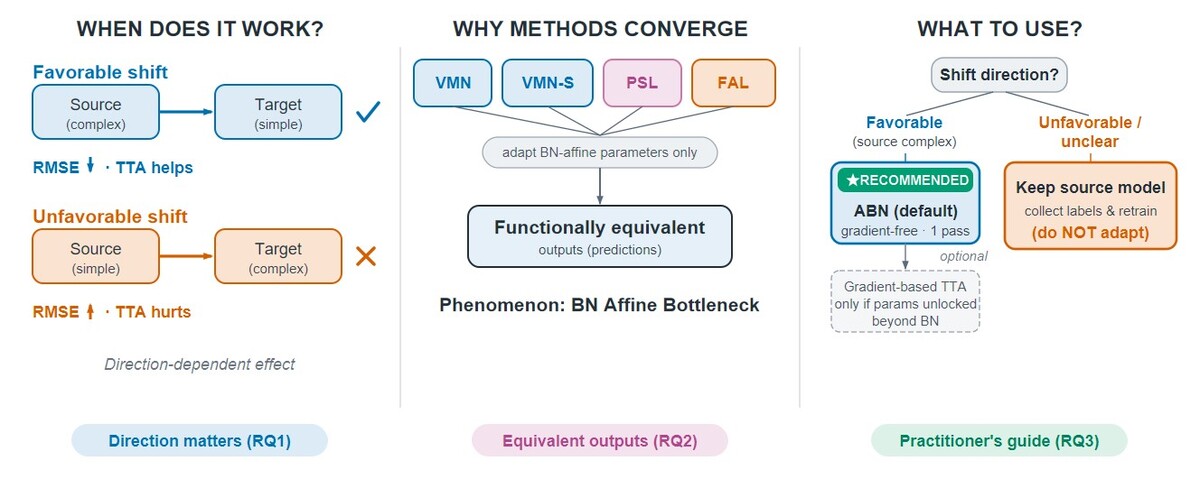
Deep learning models for remaining useful life (RUL) prediction degrade under varying operating conditions due to distribution shifts. Test-time adaptation (TTA) addresses this issue by updating a pretrained model using unlabeled target data without source data access; however, it has not been systematically studied for RUL prediction. Four TTA strategies are reformulated and evaluated across six cross-domain scenarios on C-MAPSS. TTA improves performance only when the source has more diverse operating conditions than the target. Restricting adaptation to batch-normalization (BN) affine parameters makes all gradient-based methods produce functionally equivalent outputs (BN affine bottleneck). Gradient-free adaptive BN gives the best risk–benefit trade-off, matching or outperforming them in five of six scenarios. A four-step deployment workflow for cross-domain predictive maintenance is proposed. The direction dependence of TTA effectiveness and the BN affine bottleneck are further confirmed on an LSTM backbone and the N-CMAPSS dataset.
REFERENCES (30)
1.
Kang Z, Catal C, Tekinerdogan B. Remaining useful life (RUL) prediction of equipment in production lines using artificial neural networks. Sensors 2021; 21(3): 932. https://doi.org/10.3390/s21030....
2.
Si XS, Wang W, Hu CH, Zhou DH. Remaining useful life estimation—A review on the statistical data driven approaches. European Journal of Operational Research 2011; 213(1): 1-14. https://doi.org/10.1016/j.ejor....
3.
Zheng S, Ristovski K, Farahat A, Gupta C. Long short-term memory network for remaining useful life estimation. Proceedings of the IEEE International Conference on Prognostics and Health Management (ICPHM); 2017. p. 88-95. https://doi.org/10.1109/ICPHM.....
4.
Zhang J, Wang P, Yan R, Gao RX. Long short-term memory for machine remaining life prediction. Journal of Manufacturing Systems 2018; 48: 78-86. https://doi.org/10.1016/j.jmsy....
5.
Li X, Ding Q, Sun JQ. Remaining useful life estimation in prognostics using deep convolution neural networks. Reliability Engineering & System Safety 2018; 172: 1-11. https://doi.org/10.1016/j.ress....
6.
Lea C, Flynn MD, Vidal R, Reiter A, Hager GD. Temporal convolutional networks for action segmentation and detection. Proceedings of the IEEE Conference on Computer Vision and Pattern Recognition (CVPR); 2017. p. 1003-1012. https://doi.org/10.1109/CVPR.2....
7.
Wang S, Zhang C, Lv D, Zhao W. Temporal convolutional network with attention mechanism for bearing remaining useful life prediction. In: Zhang H, Ji Y, Liu T, Sun X, Ball AD, editors. Proceedings of TEPEN 2022. Mechanisms and Machine Science, vol 129. Cham: Springer; 2023. p. 391-400. https://doi.org/10.1007/978-3-....
8.
Mo Y, Wu Q, Li X, Huang B. Remaining useful life estimation via transformer encoder enhanced by a gated convolutional unit. Journal of Intelligent Manufacturing 2021; 32(7): 1997-2006. https://doi.org/10.1007/s10845....
9.
Li X, Song K, Shi J. Degradation generation and prediction based on machine learning methods: A comparative study. Eksploatacja i Niezawodnosc – Maintenance and Reliability 2025; 27(1): 192168. https://doi.org/10.17531/ein/1....
10.
Yu S, Wu Z, Zhu X, Pecht M. A domain adaptive convolutional LSTM model for prognostic remaining useful life estimation under variant conditions. Proceedings of the 2019 Prognostics and System Health Management Conference (PHM-Paris); 2019. p. 130-137. https://doi.org/10.1109/PHM-Pa....
11.
Sun B, Feng J, Saenko K. Return of frustratingly easy domain adaptation. Proceedings of the AAAI Conference on Artificial Intelligence 2016; 30(1): 2058-2065. https://doi.org/10.1609/aaai.v....
12.
Ganin Y, Ustinova E, Ajakan H, Germain P, Larochelle H, Laviolette F, Marchand M, Lempitsky V. Domain-adversarial training of neural networks. Journal of Machine Learning Research 2016; 17(59): 1-35. https://jmlr.org/papers/v17/15....
13.
da Costa PRDO, Akçay A, Zhang Y, Kaymak U. Remaining useful lifetime prediction via deep domain adaptation. Reliability Engineering & System Safety 2020; 195: 106682. https://doi.org/10.1016/j.ress....
14.
Zhang A, Wang H, Li S, Cui Y, Liu Z, Yang G, Hu J. Transfer learning with deep recurrent neural networks for remaining useful life estimation. Applied Sciences 2018; 8(12): 2416. https://doi.org/10.3390/app812....
15.
Lv Y, Zhou N, Wen Z, Shen Z, Chen A. Remaining useful life prediction based on multisource domain transfer and unsupervised alignment. Eksploatacja i Niezawodnosc – Maintenance and Reliability 2025; 27(2): 194116. https://doi.org/10.17531/ein/1....
16.
Nejjar I, Geissmann F, Zhao M, Taal C, Fink O. Domain adaptation via alignment of operation profile for remaining useful lifetime prediction. Reliability Engineering & System Safety 2024; 242: 109718. https://doi.org/10.1016/j.ress....
17.
Hou Y, Ragab M, Wu M, Kwoh CK, Li X, Chen Z. Target-specific adaptation and consistent degradation alignment for cross-domain remaining useful life prediction. IEEE Transactions on Automation Science and Engineering 2026; 23: 3596-3606. https://doi.org/10.1109/TASE.2....
18.
Dong X, Zhang C, Liu H, Wang D, Wang T. A multi-constrained domain adaptation network for remaining useful life prediction of bearings. Mechanical Systems and Signal Processing 2024; 206: 110900. https://doi.org/10.1016/j.ymss....
19.
Liang J, He R, Tan T. A comprehensive survey on test-time adaptation under distribution shifts. International Journal of Computer Vision 2025; 133(1): 31-64. https://doi.org/10.1007/s11263....
20.
Li Y, Wang N, Shi J, Hou X, Liu J. Adaptive batch normalization for practical domain adaptation. Pattern Recognition 2018; 80: 109-117. https://doi.org/10.1016/j.patc....
21.
Wang D, Shelhamer E, Liu S, Olshausen B, Darrell T. Tent: Fully test-time adaptation by entropy minimization. International Conference on Learning Representations (ICLR). 2021. https://openreview.net/forum?i....
22.
Niu S, Wu J, Zhang Y, Chen Y, Zheng S, Zhao P, Tan M. Efficient test-time model adaptation without forgetting. Proceedings of the 39th International Conference on Machine Learning (ICML); 2022. p. 16888-16905. https://proceedings.mlr.press/....
23.
Niu S, Wu J, Zhang Y, Wen Z, Chen Y, Zhao P, Tan M. Towards stable test-time adaptation in dynamic wild world. International Conference on Learning Representations (ICLR). 2023. https://openreview.net/forum?i....
24.
Iwasawa Y, Matsuo Y. Test-time classifier adjustment module for model-agnostic domain generalization. Advances in Neural Information Processing Systems (NeurIPS) 2021; 34: 2427-2440. https://proceedings.neurips.cc....
25.
Wang Q, Fink O, Van Gool L, Dai D. Continual test-time domain adaptation. Proceedings of the IEEE/CVF Conference on Computer Vision and Pattern Recognition (CVPR); 2022. p. 7201-7211. https://doi.org/10.1109/CVPR52....
26.
Sun Y, Wang X, Liu Z, Miller J, Efros AA, Hardt M. Test-time training with self-supervision for generalization under distribution shifts. Proceedings of the 37th International Conference on Machine Learning (ICML); 2020. p. 9229-9248. https://proceedings.mlr.press/....
27.
Wu Y, Chi Z, Wang Y, Plataniotis KN, Feng S. Test-time domain adaptation by learning domain-aware batch normalization. Proceedings of the AAAI Conference on Artificial Intelligence 2024; 38(14): 15961-15969. https://doi.org/10.1609/aaai.v....
28.
Kim HG, Kim S, Mok J, Yoon S. Battling the non-stationarity in time series forecasting via test-time adaptation. Proceedings of the AAAI Conference on Artificial Intelligence 2025; 39(17): 17868-17876. https://doi.org/10.1609/aaai.v....
29.
Saxena A, Goebel K, Simon D, Eklund N. Damage propagation modeling for aircraft engine run-to-failure simulation. International Conference on Prognostics and Health Management (PHM); 2008. p. 1-9. https://doi.org/10.1109/PHM.20....
30.
Arias Chao M, Kulkarni C, Goebel K, Fink O. Aircraft engine run-to-failure dataset under real flight conditions for prognostics and diagnostics. Data 2021; 6(1): 5. https://doi.org/10.3390/data60....
Share
RELATED ARTICLE
| eISSN: | 2956-3860 |
| ISSN: | 1507-2711 |

We process personal data collected when visiting the website. The function of obtaining information about users and their behavior is carried out by voluntarily entered information in forms and saving cookies in end devices. Data, including cookies, are used to provide services, improve the user experience and to analyze the traffic in accordance with the Privacy policy. Data are also collected and processed by Google Analytics tool (more).
You can change cookies settings in your browser. Restricted use of cookies in the browser configuration may affect some functionalities of the website.
You can change cookies settings in your browser. Restricted use of cookies in the browser configuration may affect some functionalities of the website.