
RESEARCH PAPER
Two-Dimensional and Three-Dimensional Numerical Simulation Study on the Effect of Rotor Speed Ratio on Mixing Performance in Rubber Compounding
1
Jiangsu University, China
A – Conceptualization; B – Methodology; C – Software; D – Validation; E – Formal analysis; F – Investigation; G – Resources; H – Data curation; I – Writing – original draft; J – Writing – review & editing; K – Visualization; L – Supervision; M – Project administration; N – Funding acquisition
Submission date: 2026-03-02
Final revision date: 2026-04-10
Acceptance date: 2026-05-09
Online publication date: 2026-07-10
Publication date: 2026-08-13
Eksploatacja i Niezawodność – Maintenance and Reliability 2027;29(1):221637
KEYWORDS
TOPICS
ABSTRACT
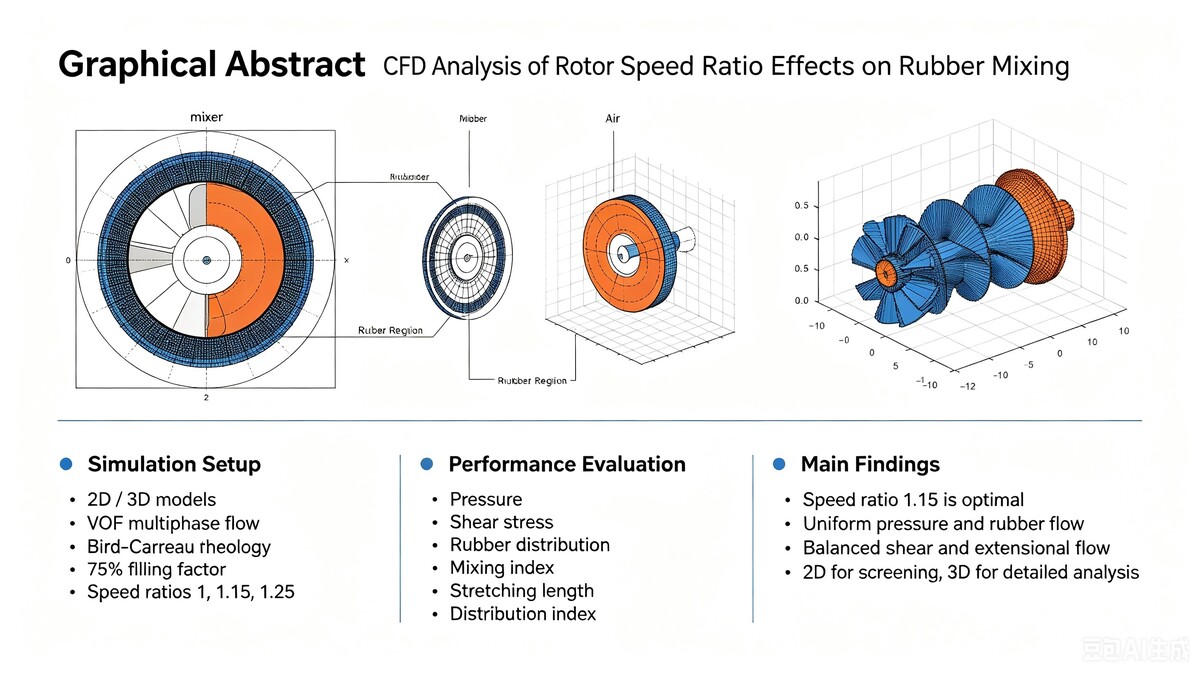
Rubber compounding constitutes a critical process step in rubber product manufacturing, where the uniformity and efficiency of the mixing process directly influence the physical properties of the compound and the overall product quality. The rotor speed ratio, as a crucial parameter in internal mixers, significantly influences material flow behaviour and shear rates. To elucidate the effects of varying rotor speed ratios on the mixing process, this study employs finite element numerical simulation to construct two-dimensional and three-dimensional mixing models. It systematically compares mixing characteristics under three operating conditions: rotor speed ratios of 1, 1.15, and 1.25. Multiple evaluation metrics were employed to analyse the rubber compounding outcomes, revealing superior compounding results under the 1.15 speed ratio condition. Furthermore, comparisons between the two-dimensional and three-dimensional model simulations demonstrated highly consistent trends in flow field analysis and key evaluation metrics.
REFERENCES (24)
1.
Zhu B. Current Status and Development Prospects of the Domestic Rubber Compounding Industry. China Rubber 2021; (4): 30.
2.
Dhakal P, Das S R, Poudyal H. Numerical simulations of partially filled rubber mixing in a 2-wing rotor-equipped chamber. Journal of Applied Polymer Science 2016;b133(48): 44250.
3.
Fu P , Bai F B , Wang C S.Optimize Mixing Process Parameters of Synchronous Rotor Mixer Based on Orthogonal Method.Key Engineering Materials 2012; 501: 442-447. DOI:10.4028/www.scientific.net/KEM.501.442.
4.
Wang G L, Wang Y. Research on non-isothermal numerical simulation algorithm for tire rubber mixing based on multiphase flow decoupling principle. International Journal of Automotive Technology 2024; 26(3): 1-12.
5.
Liu J P, Li F Z, Zhang L Q. Numerical simulation of flow of rubber compounds in partially filled internal mixer. Journal of Applied Polymer Science 2015; 132(35): 42452. doi: 10.1002/app.42452.
6.
Liu T L, Du Y X. Simulation of mixing behaviour based on POLYFLOW twin-screw continuous mixing machine. Modern Plastics Processing and Applications 2010; (5): 15-18. doi: 10.3969/j.issn.1004-3055.2010.05.007.
7.
Salahudeen S A, Alothman O, Elleithy R H. Optimization of rotor speed based on stretching, efficiency, and viscous heating in no intermeshing internal batch mixer: simulation and experimental verification. Journal of Applied Polymer Science 2012; 127(5): 4229-4238. doi: 10.1002/app.37592.
8.
Lv D W, Zhu X Z, Xin Y Y. Analysis of the movement and mixing performance of particles in an internal mixer. Plast 2020; 49(3): 54-58.
9.
Wang C S, Zhang L, Zhai T J. Finite element simulation analysis of the mixing flow field of synchronous rotor internal mixers with different initial phase angles. China Rubber Ind 2019; 66(6): 408-413.
10.
Zhai T J. Simulation and visualisation of the mixing process in a closed mixer. Qingdao (China): Qingdao University of Science and Technology; 2019.
11.
Wang K, Liu H, Chang T. Numerical optimization simulation of synchronous four-wing rotor. Materials 2020; 13(23): 5353. doi: 10.3390/ma13235353.
12.
Ahmed I, Chandy AJ, Poudyal H. Three-dimensional numerical investigations of the effect of fill factor on dispersive and distributive mixing of rubber under non-isothermal conditions. Polymer Engineering and Science 2019; 59(3): 535-546. doi: 10.1002/pen.24963.
13.
Dhakal P, Das S R, Poudyal H. Investigation of fill factor in two-wing rotor mixing of rubber by using computational fluid dynamics. Tire Science and Technology 2017; 45(2): 144-160. doi: 10.2346/tire.17.450202.
14.
Poudyal H, Ahmed I, Chandy AJ. Three-dimensional, non-isothermal simulations of the effect of speed ratio in partially filled rubber mixing. International Polymer Processing 2019; 34(2): 219-230. doi: 10.3139/217.019022.
15.
Connely R K, Kokini J L. 3D numerical simulation of the flow of viscous Newtonian and shear thinning fluids in a twin sigma blade mixer. Advances in Polymer Technology 2006; 25(3): 182-194. doi: 10.1002/adv.20071.
16.
Wang C S, Zhang J L. Three-dimensional temperature field analysis of synchronous rotors in internal mixers. China Rubber/Plastics Technol Equip 2008; (5): 1-7.
17.
Liu G C, Wang H Y, Chen R H. Experimental study on the mixing process of a 0.3 L internal mixer. China Rubber/Plastics Technol Equip 2021; 47(5): 1-6.
18.
Liu J P, Li F Z, Yang H B. Non-isothermal numerical simulation study of the three-dimensional flow field of a Hakko mixer. China Rubber Industry 2016; (7): 429-433.
19.
Wang G L, Wang J S, Zhou H C. Simulation method for rubber compounding under isothermal partial filling conditions. Advances in Polymer Technology 2023; 2023(1): 1-16. doi: 10.1155/2023/5571039.
20.
Khan M W A, Salahuddin T, Chu Y M. Analysis of the Carreau fluid model presenting physical properties along different molecular axes near an anisotropic rough surface. International Communications in Heat and Mass Transfer 2021; 123: 105233. doi: 10.1016/j.icheatmasstransfer.2021.105233.
21.
Poudyal H, Das S R, Chandy A J. Non-isothermal effects in partially filled rubber mixing simulations of manufacturing processes. Rubber Chemistry and Technology 2019; 92(1): 152-167. doi: 10.5254/rct.19.82590.
22.
Cheng J J, Manas-Zloczower I. Flow field characterization in a Banbury mixer. International Polymer Processing 1990; 5(3): 178-183. doi: 10.3139/217.900178.
23.
Ottino J M. The kinematics of mixing: stretching, chaos, and transport. Cambridge: Cambridge University Press; 1989.
24.
Wong TH, Manas-Zloczower I. Two-dimensional dynamic study of the distributive mixing in an internal mixer. International Polymer Processing 1994; 9(1): 3-10. doi: 10.3139/217.940003.
Share
RELATED ARTICLE
| eISSN: | 2956-3860 |
| ISSN: | 1507-2711 |

We process personal data collected when visiting the website. The function of obtaining information about users and their behavior is carried out by voluntarily entered information in forms and saving cookies in end devices. Data, including cookies, are used to provide services, improve the user experience and to analyze the traffic in accordance with the Privacy policy. Data are also collected and processed by Google Analytics tool (more).
You can change cookies settings in your browser. Restricted use of cookies in the browser configuration may affect some functionalities of the website.
You can change cookies settings in your browser. Restricted use of cookies in the browser configuration may affect some functionalities of the website.