
RESEARCH PAPER
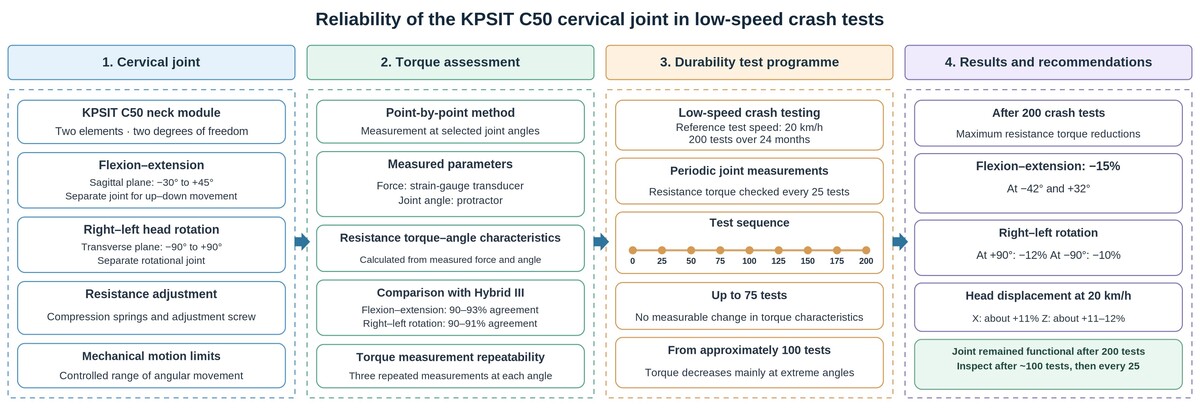
Reliability of the KPSIT C50 dummy's cervical joint in cyclic tests for low-speed collisions up to 20 km/h
1
Kielce University of Technology, Poland
2
Institute of Forensic Research and Education, ,University of Zilina, 010 26 Zilina, Slovak Republic
A – Conceptualization; B – Methodology; C – Software; D – Validation; E – Formal analysis; F – Investigation; G – Resources; H – Data curation; I – Writing – original draft; J – Writing – review & editing; K – Visualization; L – Supervision; M – Project administration; N – Funding acquisition
Submission date: 2026-04-07
Final revision date: 2026-05-27
Acceptance date: 2026-08-10
Online publication date: 2026-10-30
Corresponding author
KEYWORDS
TOPICS
ABSTRACT
The durability and stability of the cervical joint system of the KPSIT C50 crash dummy were evaluated. The two-element neck module has two degrees of freedom, enabling flexion-extension and right-left rotation. Drag torque characteristics were measured on a test bench using the point method, combining force and angular deflection measurements and compared with the Hybrid III reference dummy in the usable range. Durability was assessed in 200 crash tests over 24 months, with drag torque checked every 25 tests. No major parameter changes were found up to 75 tests. From about 100 tests, drag torque gradually decreased, mainly in the extreme motion zones. After 200 tests, the maximum reduction reached about 15% in flexion-extension and about 12% and 10% in rotation, while values in the central range remained stable. A 20 km/h frontal collision test showed larger head displacements after the program, indicating moderate growth in cervical compliance without loss of repeatability. The results confirm suitability for low-spin tests and support periodic torque checks after about 100 crashes.
REFERENCES (35)
1.
Li F, Liu N S, Li H G, Zhang B, Tian S W, Tan M G, Sandoz B. A review of neck injury and protection in vehicle accidents. Transportation Safety and Environment 2019; 1(2): 89-105. https://doi.org/10.1093/tse/td....
2.
Cormier J, Gwin L, Reinhart L, Wood R, Bain C. A comprehensive review of low-speed rear impact volunteer studies and a comparison to real-world outcomes. Spine 2018; 43(18): 1250-1258. https://doi.org/10.1097/BRS.00....
3.
D’Elia A, Newstead S. Retrospective evaluation of vehicle whiplash-reducing head restraint systems to prevent whiplash injury in Victoria, Australia. Accident Analysis & Prevention 2021; 150: 105941. https://doi.org/10.1016/j.aap.....
4.
Gu H M, Lou L, Chen C. Research on Evaluation Method of Occupant Neck Injury in Whiplash Test. Applied Mechanics and Materials 2014; 697: 373-376. https://doi.org/10.4028/www.sc....
5.
Trempel R E, Zuby D S, Edwards M A. IIHS head restraint ratings and insurance injury claim rates. Traffic Injury Prevention 2016; 17(6): 590-596. https://doi.org/10.1080/153895....
6.
Kullgren A, Lie A, Tingvall C. Comparison between Euro NCAP test results and real-world crash data. Traffic Injury Prevention 2010; 11(6): 587-593. https://doi.org/10.1080/153895....
7.
DeRosia J, Yoganandan N, Pintar F A. Rear impact responses of different sized adult Hybrid III dummies. Traffic Injury Prevention 2004; 5(1): 50-55. https://doi.org/10.1080/153895....
8.
Hynd D, Depinet P, Lorenz B. The repeatability and reproducibility of the BioRID IIg in a repeatable laboratory seat based on a production car seat. Traffic Injury Prevention 2013; 14(Suppl 1): S95-S104. https://doi.org/10.1080/153895....
9.
Kim A, Anderson K F, Berliner J, Bryzik C, Hassan J, Jensen J, Kendall M, Mertz H J, Morrow T, Rao A, Wozniak J A. A comparison of the Hybrid III and BioRID II dummies in low-severity, rear-impact sled tests. Stapp Car Crash Journal 2001; 45: 257-284. https://doi.org/10.4271/2001-2....
10.
Cappon H, Philippens M, van Ratingen M, Wismans J. Development and evaluation of a new rear-impact crash dummy: The RID2. Stapp Car Crash Journal 2001; 45: 225-238. https://doi.org/10.4271/2001-2....
11.
Kim A, Anderson K F, Berliner J, Hassan J, Jensen J, Mertz H J, Pietsch H, Rao A, Scherer R, Sutterfield A. A biofidelity evaluation of the BioRID II, Hybrid III and RID2 for use in rear impacts. Stapp Car Crash Journal 2003; 47: 489-523. https://doi.org/10.4271/2003-2....
12.
Cusick J F, Pintar F A, Yoganandan N. Whiplash syndrome: Kinematic factors influencing pain patterns. Spine 2001; 26(11): 1252-1258. https://doi.org/10.1097/000076....
13.
Albert D L, Beeman S M, Kemper A R. Comparative biofidelity of the Hybrid III and THOR 50th male ATDs under three restraint conditions during frontal sled tests. Traffic Injury Prevention 2023; 24(Suppl 1): S41-S46. https://doi.org/10.1080/153895....
14.
Wang Z J, Humm J, Hauschild H W. Investigation of THOR-AV 5F biofidelity in sled test conditions with a semi-rigid seat. Stapp Car Crash Journal 2024; 67: 78-111. https://doi.org/10.4271/2023-2....
15.
Wang Z. Biomechanical responses of the THOR-AV ATD in rear facing test conditions. SAE International Journal of Advances and Current Practices in Mobility 2022; 4(6): 2089-2105. https://doi.org/10.4271/2022-0....
16.
Liu C, Wang Z. Dummy positioning at reclined seating position before impact testing. SAE Technical Papers 2024; 2024-01-2490. https://doi.org/10.4271/2024-0....
17.
Panjabi M M, Cholewicki J, Nibu K, Babat L B, Dvorak J. Simulation of whiplash trauma using whole cervical spine specimens. Spine 1998; 23(1): 17-24. https://doi.org/10.1097/000076....
18.
Parenteau C S, Viano D C, Hardy W N. Response corridors for blunt impacts to the back. SAE International Journal of Transportation Safety 2021; 9(1): 123-138. https://doi.org/10.4271/09-09-....
19.
Xu T, Sheng X, Zhang T, Liu H, Liang X, Ding A. Development and validation of dummies and human models used in crash test. Applied Bionics and Biomechanics 2018; 2018: 3832850. https://doi.org/10.1155/2018/3....
20.
Johnson D, Koya B, Gayzik F S. Comparison of neck injury criteria values across human body models of varying complexity. Frontiers in Bioengineering and Biotechnology 2020; 8: 985. https://doi.org/10.3389/fbioe.....
21.
Frej D. Analysis of head displacement during a frontal collision at a speed of 20 km/h—Experimental studies. Sustainability 2023; 15(22): 16015. https://doi.org/10.3390/su1522....
22.
Jaśkiewicz M. Evaluation of the reliability of the shoulder and knee joint of the KPSIT C50 dummy adapted to crash tests carried out at low speeds. Eksploatacja i Niezawodność – Maintenance and Reliability 2024; 26(1): 178376. https://doi.org/10.17531/ein/1....
23.
Kang Y S, Stammen J, Agnew A M, Baker G H, Pradhan V, Bendig A, Hagedorn A, Moorhouse K, Bolte J H IV. Thoracic responses and injuries to male postmortem human subjects (PMHS) in rear-facing seat configurations in high-speed frontal impacts. Traffic Injury Prevention 2023; 24(Suppl 1): S47-S54. https://doi.org/10.1080/153895....
24.
Honcu P, Zach P, Mrzilkova J, Jandova D, Musil V, Celko A M. Computer kinesiology: New diagnostic and therapeutic tool for lower back pain treatment (pilot study). BioMed Research International 2020; 2020: 2987696. https://doi.org/10.1155/2020/2....
25.
Blanpied P R, Gross A R, Elliott J M, Devaney L L, Clewley D, Walton D M, Sparks C, Robertson E K. Neck pain: Revision 2017. Journal of Orthopaedic & Sports Physical Therapy 2017; 47(7): A1-A83. https://doi.org/10.2519/jospt.....
26.
Malis V, Sinha U, Sinha S. 3D muscle deformation mapping at submaximal isometric contractions: Applications to aging muscle. Frontiers in Physiology 2020; 11: 600590. https://doi.org/10.3389/fphys.....
27.
Frich L H, Lambertsen K L, Hjarbaek J, Sanchez Dahl J, Holsgaard-Larsen A. Musculoskeletal application and validation of speckle-tracking ultrasonography. BMC Musculoskeletal Disorders 2019; 20: 192. https://doi.org/10.1186/s12891....
28.
Winter D A. Biomechanics and Motor Control of Human Movement. 4th ed. Hoboken, NJ: John Wiley & Sons; 2009. https://doi.org/10.1002/978047....
29.
Bansal M, Jeffriess L, Leano R, Mundy J, Marwick T H. Assessment of myocardial viability at dobutamine echocardiography by deformation analysis using tissue velocity and speckle-tracking. JACC: Cardiovascular Imaging 2010; 3(2): 121-131. https://doi.org/10.1016/j.jcmg....
30.
Mohan P, Marzougui D, Kan C D. Development and validation of Hybrid III crash test dummy. SAE Technical Papers 2009; 2009-01-0473. https://doi.org/10.4271/2009-0....
31.
Frej D. Badania symulacyjne i eksperymentalne manekinów antropometrycznych z uwzględnieniem działania pasów bezpieczeństwa dla różnych typów zderzeń. Doctoral dissertation. Kielce: Politechnika Świętokrzyska; 2022.
32.
Prochowski L, Zielonka K, Żuchowski A. The analysis of occupant motion in frontal barrier impact of a chassis frame vehicle. Journal of KONES Powertrain and Transport 2011; 18(1): 491-502.
33.
Prochowski L, Fitas M, Zielonka K. Analysing the results of research on the influence of the position of a seat belt on the movements and dynamic loads of child's head and torso during a bus impact against an obstacle. The Archives of Automotive Engineering – Archiwum Motoryzacji 2014; 66: 43-56.
34.
Prochowski L, Zielonka K. Dynamic loads exerted on legs of seated passengers during frontal collision of a bus with an obstacle. Journal of KONES Powertrain and Transport 2010; 17(3): 377-384.
35.
Żuchowski A, Prochowski L, Zielonka K. Ocena ryzyka obrażeń pasażerów podczas wypadku drogowego mikrobusu, jako kryterium doskonalenia konstrukcji foteli i ich rozmieszczenia. Logistyka 2014; 3: 7166-7174.
Share
RELATED ARTICLE
| eISSN: | 2956-3860 |
| ISSN: | 1507-2711 |

We process personal data collected when visiting the website. The function of obtaining information about users and their behavior is carried out by voluntarily entered information in forms and saving cookies in end devices. Data, including cookies, are used to provide services, improve the user experience and to analyze the traffic in accordance with the Privacy policy. Data are also collected and processed by Google Analytics tool (more).
You can change cookies settings in your browser. Restricted use of cookies in the browser configuration may affect some functionalities of the website.
You can change cookies settings in your browser. Restricted use of cookies in the browser configuration may affect some functionalities of the website.