
RESEARCH PAPER
Bi-objective Dynamic Group Maintenance Optimization for a Heterogeneous Two-Component System with Bidirectional Coupling and Economic Dependence: A Rolling Time-Domain Approach Based on NSGA-II
1
Shijiazhuang Campus, Army Engineering University, China
A – Conceptualization; B – Methodology; C – Software; D – Validation; E – Formal analysis; F – Investigation; G – Resources; H – Data curation; I – Writing – original draft; J – Writing – review & editing; K – Visualization; L – Supervision; M – Project administration; N – Funding acquisition
Submission date: 2026-02-13
Final revision date: 2026-05-07
Acceptance date: 2026-06-09
Online publication date: 2026-07-14
Publication date: 2026-08-13
Eksploatacja i Niezawodność – Maintenance and Reliability 2027;29(1):224350
KEYWORDS
group maintenanceheterogeneous componentsstochastic dependencieseconomic dependenciesbidirectional coupling
TOPICS
- Reliability modelling for maintenance of technical items
- Safety and risk assessment for maintenance of technical systems
- Monitoring and diagnostics for maintenance of technical systems
- Maintenance economics for machines, devices and technical systems
- Quality and reliability for technical items
- Operation and maintenance processes for technical items
- Physics of Failure and Degradation Modelling
- Reliability, Availability, Maintainability and Safety Analysis
- Maintenance Engineering, Asset Management, Life Cycle Costs and Logistics
- Diagnostics, Condition Monitoring and Fault Detection
ABSTRACT
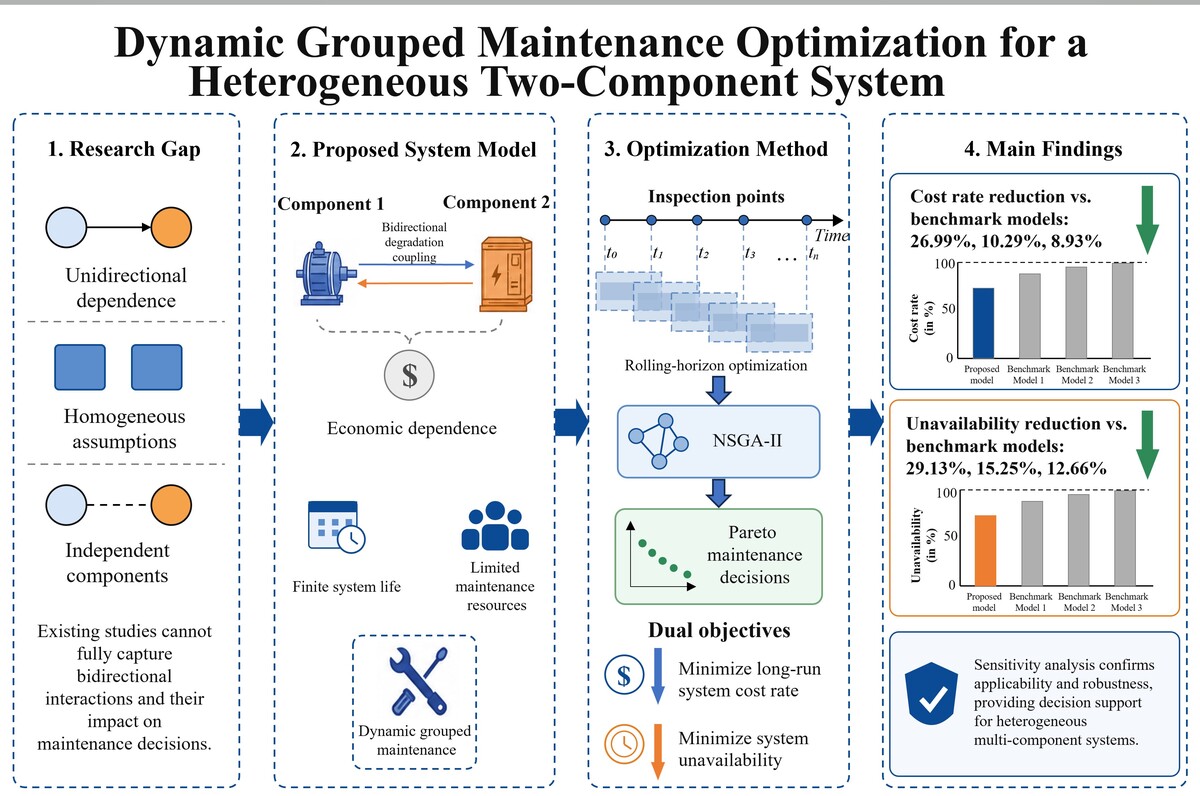
Existing studies on multi-component maintenance often model component dependence as unidirectional, homogeneous, or independent, which limits their ability to capture bidirectional interactions and their impact on maintenance decisions. This paper proposes a dynamic grouped maintenance optimization model for a heterogeneous two-component system with bidirectional degradation coupling and economic dependence. The model minimizes the long-run system cost rate and unavailability under finite system life and limited maintenance resources. A rolling-horizon method based on NSGA-II is developed to obtain Pareto maintenance decisions at each inspection point, and the model is validated through simulations. Under the same coupling strength, the proposed strategy reduces the long-run cost rate by 26.99%, 10.29%, and 8.93%, and system unavailability by 29.13%, 15.25%, and 12.66%, respectively, compared with benchmark models. Sensitivity analysis further confirms its applicability and robustness, providing decision support for heterogeneous multi-component systems.
REFERENCES (54)
1.
Nicolai RP, Dekker R. Optimal Maintenance of Multi-component Systems: A Review. In: Kobbacy KAH, Murthy DNP, eds. Complex System Maintenance Handbook. London: Springer London; 2008. pp. 263–86. https://doi.org/10.1007/978-1-... doi:10.1007/978-1-84800-011-7_11.
2.
Wildeman RE, Dekker R, Smit ACJM. A dynamic policy for grouping maintenance activities. European Journal of Operational Research 1997; 99(3): 530-51. doi:10.1016/S0377-2217(97)00319-6.
3.
Wildeman RE, Dekker R. Dynamic influences in multi-component maintenance. Quality and Reliability Engineering International 1997; 13(4): 199-207. doi:10.1002/(SICI)1099-1638(199707)13:4<199::AID-QRE118>3.0.CO;2-A.
4.
Van PD, Vu HC, Barros A, Berenguer C. Grouping maintenance strategy with availability constraint under limited repairmen. IFAC Proceedings Volumes 2012; 45(20): 486-91. doi:10.3182/20120829-3-MX-2028.00194.
5.
Nguyen VT, Do P, Franciosi C, Voisin A, Iung B, Li L. Dynamic Grouping in Maintenance Planning and Optimization: an Industrial Application. IFAC-PapersOnLine 2024; 58(19): 504-9. doi:10.1016/j.ifacol.2024.09.262.
6.
Xu J, Liu B, Zhao X, Wang XL. Online reinforcement learning for condition-based group maintenance using factored Markov decision processes. European Journal of Operational Research 2024; 315(1): 176-90. doi:10.1016/j.ejor.2023.11.039.
7.
Do Van P, Barros A, Bérenguer C, Bouvard K, Brissaud F. Dynamic grouping maintenance with time-limited opportunities. Reliability Engineering & System Safety 2013; 120: 51-9. doi:10.1016/j.ress.2013.03.016.
8.
Olde Keizer MCA, Flapper SDP, Teunter RH. Condition-based maintenance policies for systems with multiple dependent components: A review. European Journal of Operational Research 2017; 261(2): 405-20. doi:10.1016/j.ejor.2017.02.044.
9.
Bafandegan Emroozi V, Kazemi M, Doostparast M. Enhancing industrial maintenance planning: Optimization of human error reduction and spare parts management. Operations Research Perspectives 2025; 14: 100336. doi:10.1016/j.orp.2025.100336.
10.
Do P, Vu HC, Barros A, Bérenguer C. Maintenance grouping for multi-component systems with availability constraints and limited maintenance teams. Reliability Engineering & System Safety 2015; 142: 56-67. doi:10.1016/j.ress.2015.04.022.
11.
Nguyen T, Deloux E, Dieullez L. Maintenance policies for a heterogeneous two-component system with stochastic and economic dependencies. IFAC-PapersOnLine 2016; 49(12): 787-92. doi:10.1016/j.ifacol.2016.07.870.
12.
Zhang N, Fouladirad M, Barros A, Zhang J. Condition-based maintenance for a K-out-of-N deteriorating system under periodic inspection with failure dependence. European Journal of Operational Research 2020; 287(1): 159-67. doi:10.1016/j.ejor.2020.04.041.
13.
Wang Y, Li X, Chen J, Liu Y. A condition-based maintenance policy for multi-component systems subject to stochastic and economic dependencies. Reliability Engineering & System Safety 2022; 219: 108174. doi:10.1016/j.ress.2021.108174.
14.
Zhang Z, Wu S, Li B, Lee S. Optimal maintenance policy for multi-component systems under Markovian environment changes. Expert Systems with Applications 2013; 40(18): 7391-9. doi:10.1016/j.eswa.2013.07.003.
15.
Huynh KT, Vu HC, Nguyen TD, Ho AC. A predictive maintenance model for k-out-of-n:F continuously deteriorating systems subject to stochastic and economic dependencies. Reliability Engineering & System Safety 2022; 226: 108671. doi:10.1016/j.ress.2022.108671.
16.
Han Q, Ding Z, Xu X, Wang T, Chu F. Stator current model for detecting rolling bearing faults in induction motors using magnetic equivalent circuits. Mechanical Systems and Signal Processing 2019; 131: 554-75. doi:10.1016/j.ymssp.2019.06.010.
17.
Hao J, Yao Z, Li C, Liu C, Hua C, Yu C, et al. Nonlinear electromechanical coupling integrated modeling and analysis of motorized spindle under mechanical and electromagnetic loads. Nonlinear Dynamics 2025; 113(11): 12817-66. doi:10.1007/s11071-025-10865-2.
18.
Li Z, Cai R, Nie X. Experimental Study: Bearing Degradation Caused by Electrical Currents and Voltages at Low Speeds. Lubricants 2025; 13(4). doi:10.3390/lubricants13040175.
19.
Song M, Liang Z. A hierarchical state ordering method for heterogeneous k-out-of-n:F systems with multi-state load-sharing components. Reliability Engineering & System Safety 2025; 262: 111167. doi:10.1016/j.ress.2025.111167.
20.
Lu B, Wang X, Cui W, Ye Z. A predictive opportunistic maintenance policy for a serial–parallel multi-station manufacturing system with heterogeneous components. Reliability Engineering & System Safety 2025; 256: 110711. doi:10.1016/j.ress.2024.110711.
21.
Kivanç İ, Fecarotti C, Raassens N, Van Houtum GJ. A scalable multi-objective maintenance optimization model for systems with multiple heterogeneous components and a finite lifespan. European Journal of Operational Research 2024; 315(2): 567-79. doi:10.1016/j.ejor.2023.12.005.
22.
Bautista L, Castro IT, Landesa L. Maintenance cost assessment for heterogeneous multi-component systems incorporating perfect inspections and waiting time to maintenance. arXiv; 2024 [acessed 12 december 2025]. http://arxiv.org/abs/2401.1153... doi:10.48550/arXiv.2401.11538.
23.
Bautista L, Castro IT, Nardo MD, Murino T. Condition-based and age-based maintenance in a multi-component system with heterogeneous components incorporating imperfect preventive maintenance actions. Computers & Industrial Engineering 2025; 206: 111188. doi:10.1016/j.cie.2025.111188.
24.
Kıvanç İ, Fecarotti C, Raassens N, van Houtum GJ. Condition-based maintenance for multi-component systems: A scalable optimization model with two thresholds. Reliability Engineering & System Safety 2025; 254: 110634. doi:10.1016/j.ress.2024.110634.
25.
Zhao Y, Cozzani V, Sun T, Vatn J, Liu Y. Condition-based maintenance for a multi-component system subject to heterogeneous failure dependencies. Reliability Engineering & System Safety 2023; 239: 109483. doi:10.1016/j.ress.2023.109483.
26.
Zeng J, Liang Z. A dynamic predictive maintenance approach using probabilistic deep learning for a fleet of multi-component systems. Reliability Engineering & System Safety 2023; 238: 109456. doi:10.1016/j.ress.2023.109456.
27.
He R, Tian Z, Wang Y, Zuo M, Guo Z. Condition-based maintenance optimization for multi-component systems considering prognostic information and degraded working efficiency. Reliability Engineering & System Safety 2023; 234: 109167. doi:10.1016/j.ress.2023.109167.
28.
Geurtsen M, Leenen C, Adan I, Atan Z. Deep reinforcement learning for optimal planning of production line maintenance with deterioration. Reliability Engineering & System Safety 2026; 266: 111767. doi:10.1016/j.ress.2025.111767.
29.
Tan S, Hu Q, Guo C, Zhu D, Dong E, Zhang F. Operational readiness-oriented condition-based maintenance and spare parts optimization for multi-state systems. Reliability Engineering & System Safety 2025; 264: 111367. doi:10.1016/j.ress.2025.111367.
30.
Ma WN, Li H, Yang ZY, Hu QW. Maintenance Optimization for Two-Component Series Systems With Degradation Dependence. IEEE Access 2021; 9: 48174-84. doi:10.1109/ACCESS.2021.3062567.
31.
Lu H, Yu M, Zhang B. Multistage Prognosis for Nonlinear Electromechanical Systems with Degradation Coupling and Maintenance. IEEE Transactions on Industrial Informatics 2024; 20(4): 6009-18. doi:10.1109/TII.2023.3342425.
32.
Cui H, Tian W, Xu H, Wang H, Huang J, Peng C, et al. The Reliability of Complex Components under Temperature Cycling, Random Vibration, and Combined Loading for Airborne Applications. Crystals 2023; 13(3). doi:10.3390/cryst13030473.
33.
Islam AMA, Vatn J. Condition-based multi-component maintenance decision support under degradation uncertainties. International Journal of System Assurance Engineering and Management 2023; 14(S4): 961-79. doi:10.1007/s13198-023-01900-9.
34.
Cui L. Discussion of virtual age: Is it real? 2020 [acessed 6 december 2025]. https://onlinelibrary.wiley.co....
35.
Brenière L, Doyen L, Bérenguer C. Virtual age models with time-dependent covariates: A framework for simulation, parametric inference, and quality of estimation. Reliability Engineering & System Safety 2020; 203: 107054. doi:10.1016/j.ress.2020.107054.
36.
Yang B, Huo J, Yang B, Huo J. A Multi-Level Nonlinear Cumulative Fatigue Damage Life Prediction Model Considering Load Loading Effects. Materials 2025; 18(17). doi:10.3390/ma18173973.
37.
Liu X, Ma M. Cumulative fatigue damage theories for metals: review and prospects. International Journal of Structural Integrity 2023; 14(5): 629-62. doi:10.1108/ijsi-09-2022-0119.
38.
Yi H, Zhang W, Wang G, Zhang X, Zhai Q. Statistical multivariate degradation modeling– A systematic review. Reliability Engineering & System Safety 2025; 264: 111286. doi:10.1016/j.ress.2025.111286.
39.
Fang G, Pan R, Hong Y. Copula-based reliability analysis of degrading systems with dependent failures. Reliability Engineering & System Safety 2020; 193: 106618. doi:10.1016/j.ress.2019.106618.
40.
Pan G, Ding X, Li D, Li Y, Wang Y. A reliability evaluation method of complex electromechanical products based on the multi-stress coupling acceleration model. Engineering Failure Analysis 2023; 146: 107115. doi:10.1016/j.engfailanal.2023.107115.
41.
Saberzadeh Z, Razmkhah M. Reliability of degrading complex systems with two dependent components per element. Reliability Engineering & System Safety 2022; 222: 108398. doi:10.1016/j.ress.2022.108398.
42.
Zheng Y, Zhang Y. Reliability analysis for systems with dependent components based on survival signature and copula theory. Reliability Engineering & System Safety 2023; 238: 109402. doi:10.1016/j.ress.2023.109402.
43.
Castro IT, Landesa L. A dependent complex degrading system with non-periodic inspection times. arXiv; 2024 [acessed 6 december 2025]. http://arxiv.org/abs/2401.0914... doi:10.48550/arXiv.2401.09141.
44.
Liu B, Pandey MD, Wang X, Zhao X. A finite-horizon condition-based maintenance policy for a two-unit system with dependent degradation processes. European Journal of Operational Research 2021; 295(2): 705-17. doi:10.1016/j.ejor.2021.03.010.
45.
Zhang W, Zhang X, He S, Zhao X, He Z. Optimal condition-based maintenance policy for multi-component repairable systems with economic dependence in a finite-horizon. Reliability Engineering & System Safety 2024; 241: 109612. doi:10.1016/j.ress.2023.109612.
46.
Do P, Assaf R, Scarf P, Iung B. Modelling and application of condition-based maintenance for a two-component system with stochastic and economic dependencies. Reliability Engineering & System Safety 2019; 182: 86-97. doi:10.1016/j.ress.2018.10.007.
47.
Dekker R. Applications of maintenance optimization models; a review and analysis. Reliability Engineering & Systems Safety 1996; 51: 229-40. doi:10.1016/0951-8320(95)00076-3.
48.
Wang H. A survey of maintenance policies for deteriorating systems. European Journal of Operational Research 2002; 139(3): 469-89. doi:10.1016/S0377-2217(01)00197-7.
49.
Chang F, Zhou G, Zhang C, Xiao Z, Wang C. A service-oriented dynamic multi-level maintenance grouping strategy based on prediction information of multi-component systems. Journal of Manufacturing Systems 2019.
50.
Di Nardo M, Murino T, Cammardella A, Wu J, Song M. Catalyzing industrial evolution: A dynamic maintenance framework for Maintenance 4.0 optimization. Computers & Industrial Engineering 2024; 196: 110469. doi:10.1016/j.cie.2024.110469.
51.
Shi Y, Zhu W, Xiang Y, Feng Q. Condition-based maintenance optimization for multi-component systems subject to a system reliability requirement. Reliability Engineering & System Safety 2020; 202: 107042. doi:10.1016/j.ress.2020.107042.
52.
Gutierrez-Miravete E. Determination of the Optimal Replacement Age for the Preventive Maintenance of Bearing Assemblies Involving Weibull Failure Probability Distribution Functions. Universal Journal of Mechanical Engineering 2020; 8(6): 287-97. doi:10.13189/ujme.2020.080601.
53.
Wang Y, Wang G, Wu Y, Zhang G, Zheng R. Optimal predictive maintenance for a nonstationary gamma process. Eksploatacja i Niezawodnosc - Maintenance and Reliability 2025; 27(4). http://doi.org/10.17531/ein/20....
54.
Vu HC, Do P, Barros A, Bérenguer C. Maintenance grouping strategy for multi-component systems with dynamic contexts. Reliability Engineering & System Safety 2014; 132: 233-49. doi:10.1016/j.ress.2014.08.002.
| eISSN: | 2956-3860 |
| ISSN: | 1507-2711 |

We process personal data collected when visiting the website. The function of obtaining information about users and their behavior is carried out by voluntarily entered information in forms and saving cookies in end devices. Data, including cookies, are used to provide services, improve the user experience and to analyze the traffic in accordance with the Privacy policy. Data are also collected and processed by Google Analytics tool (more).
You can change cookies settings in your browser. Restricted use of cookies in the browser configuration may affect some functionalities of the website.
You can change cookies settings in your browser. Restricted use of cookies in the browser configuration may affect some functionalities of the website.