
RESEARCH PAPER
An Interpretable Fault Diagnosis Framework via Dual-Mamba Driven Small Model and Fine-Tuned LLM Collaboration
1
School Of Computer Science And Engineering, Shenyang Jianzhu University, Shenyang, China
2
Liaoning Provincial Key Laboratory of Big Data Management and Analysis of Urban Construction, Shenyang, China
A – Conceptualization; B – Methodology; C – Software; D – Validation; E – Formal analysis; F – Investigation; G – Resources; H – Data curation; I – Writing – original draft; J – Writing – review & editing; K – Visualization; L – Supervision; M – Project administration; N – Funding acquisition
Submission date: 2026-01-06
Final revision date: 2026-04-23
Acceptance date: 2026-08-14
Online publication date: 2026-09-07
Corresponding author
JiaWen Zhuang
School Of Computer Science And Engineering, Shenyang Jianzhu University, Shenyang, 110168, China
School Of Computer Science And Engineering, Shenyang Jianzhu University, Shenyang, 110168, China
KEYWORDS
Bearing fault diagnosisMultimodal fusionInterpretabilityDual Mamba modelsLarge–small model collaborationAdaptive routing mechanism
TOPICS
ABSTRACT
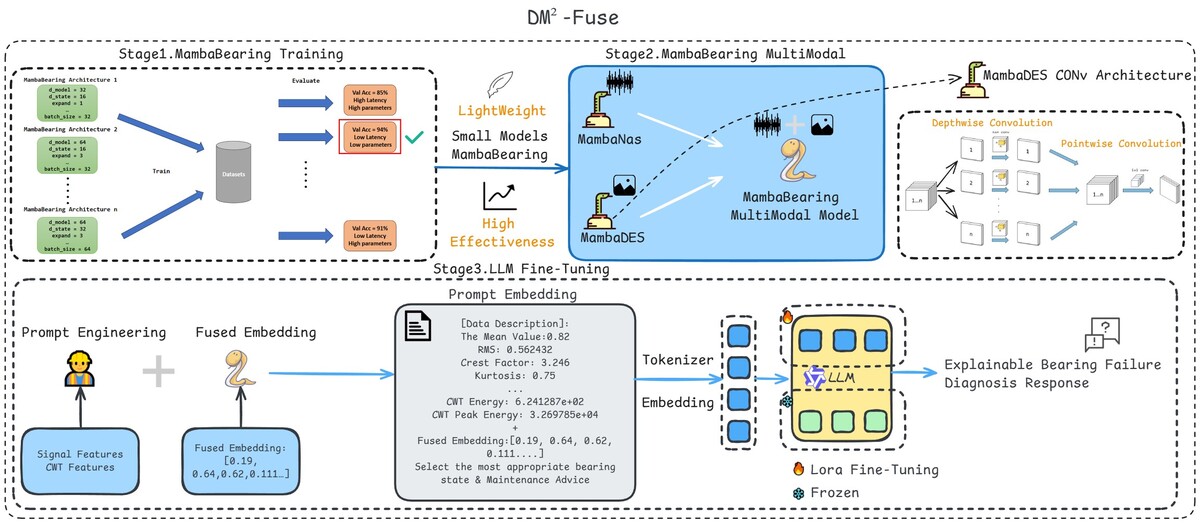
With the advent of Industry 4.0/5.0, bearing fault diagnosis is crucial for intelligent manufacturing. This paper proposes DM²-Fuse, an interpretable multimodal framework based on large–small model collaboration. It integrates lightweight Mamba variants—MambaNAS (for raw vibration signals) and MambaDES (for time–frequency representations)—into MambaBearing to extract multimodal features. These are input to an LLM for diagnostic decisions and structured reports. Experiments on CWRU, JNU, and SEU show that the multimodal MambaBearing model achieves 99.41%–100% accuracy with only 146.4K parameters. MambaNAS achieves 40,009 samples/s encoder throughput (1.17× WDCNN), while MambaDES is 11.7× faster than ResNet18. Ablations confirm NAS and separable convolutions contribute +4.8% and +1.3% accuracy, respectively. An adaptive routing mechanism reduces average LLM latency by 86%, and extensive noise and cross-domain experiments validate practical robustness. The framework reduces computation, maintains high accuracy, and enhances interpretability for industrial deployment.
| eISSN: | 2956-3860 |
| ISSN: | 1507-2711 |

We process personal data collected when visiting the website. The function of obtaining information about users and their behavior is carried out by voluntarily entered information in forms and saving cookies in end devices. Data, including cookies, are used to provide services, improve the user experience and to analyze the traffic in accordance with the Privacy policy. Data are also collected and processed by Google Analytics tool (more).
You can change cookies settings in your browser. Restricted use of cookies in the browser configuration may affect some functionalities of the website.
You can change cookies settings in your browser. Restricted use of cookies in the browser configuration may affect some functionalities of the website.