
RESEARCH PAPER
PoC for a system to monitor overloads on the chassis of a high-mobility wheeled vehicle

1
Katedra Podstaw Konstrukcji Maszyn i Układów Mechatronicznych, Politechnika Wrocławska, Poland
A – Conceptualization; B – Methodology; C – Software; D – Validation; E – Formal analysis; F – Investigation; G – Resources; H – Data curation; I – Writing – original draft; J – Writing – review & editing; K – Visualization; L – Supervision; M – Project administration; N – Funding acquisition
Submission date: 2026-04-23
Final revision date: 2026-08-03
Acceptance date: 2026-11-13
Online publication date: 2026-11-23
Corresponding author
Mariusz Kosobudzki
Katedra Podstaw Konstrukcji Maszyn i Układów Mechatronicznych, Politechnika Wrocławska, Wybrzeze Wyspiańskiego 27, 50-370, Wrocław, Poland
HIGHLIGHTS
- PoC of an on-line system for monitoring overloads of the vehicle load-bearing structure
- Design of an original transducer to measure the load of the load-bearing structure
- Transformation in the maintenance system of high-mobility wheeled vehicles
KEYWORDS
TOPICS
ABSTRACT
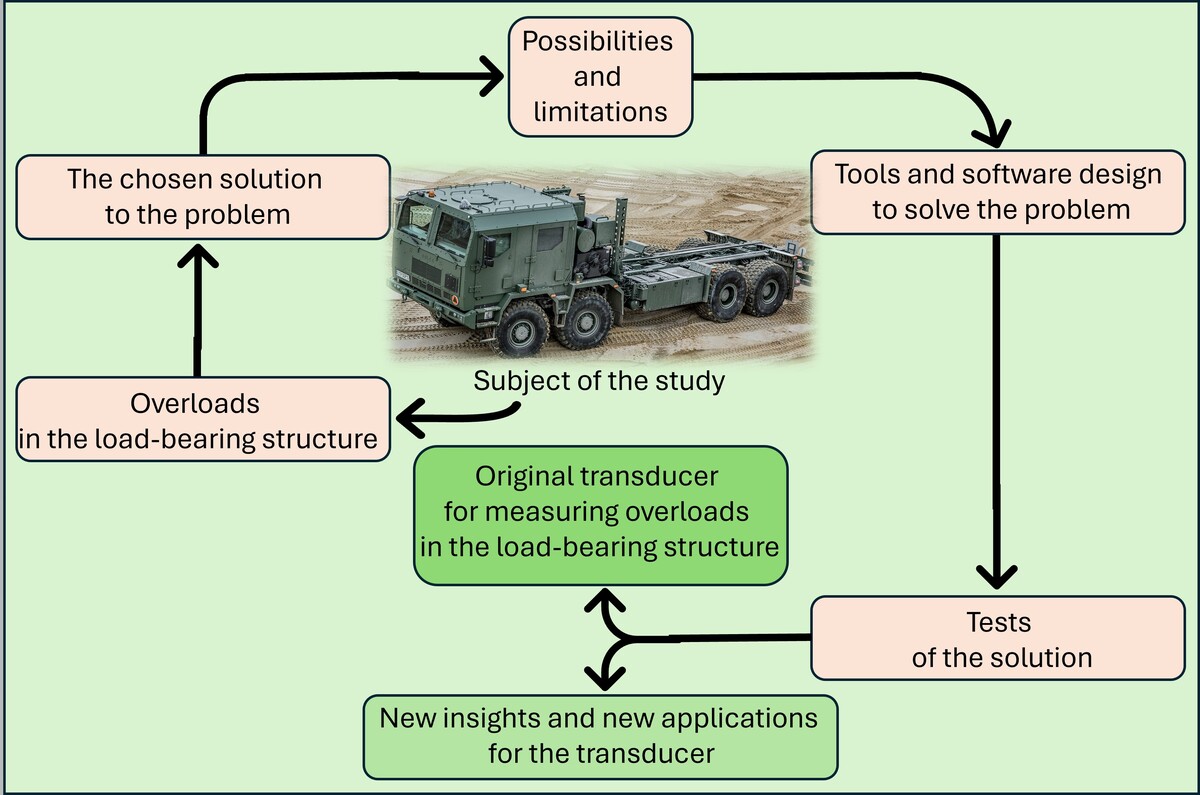
During the vehicle’s service life, the loads on its load-bearing structure may, in certain situations, approach or even exceed admissible values and cause even permanent deformation, eliminating the vehicle from further use. Such loads may arise not only whilst driving, but also when additional equipment installed on the vehicle chassis is used incorrectly. An example of such a situation would be when a container structure joined to a chassis with an additionally armored cab is lifted to a position in which the vehicle’s wheels do not touch the ground. Such loads can lead to significant stress and strain on key load-bearing components of the vehicle and, for safety reasons, should be monitored. The load history of the vehicle’s structural components can be measured by designing an appropriate measurement system. This article presents a PoC (Proof of Concept) for a system to monitor overloads in the load-bearing structure of vehicle, based on an original transducer designed especially for this purpose to measure the deformation of the vehicle frame side member.
REFERENCES (43)
1.
ASTM E1926:2021, Standard Practice for Computing International Roughness Index of Roads from Longitudinal Profile Measurements. https://store.astm.org/e1926-0...; 2026 [accessed 22.04.2026].
2.
ISO 8608:2016, Mechanical vibration — Road Surface profiles — Reporting of measured data. https://www.iso.org/standard/7...; 2026 [accessed 22.04.2026].
3.
NO23-A502-1:2010, Military technology - Research of military mechanical vehicles - Part 1: Introduction, requirements and recommendations. https://wcnjik.wp.mil.pl/; 2026 [accessed 17.04.2026].
4.
Grašič L, Lerher T, Rosi B. Evaluating costs of vehicle use in military logistics. Tehnicki vjesnik - Technical Gazette 2016; 23(6):1679-1686. https://doi.org/ 10.17559/TV-20150522141708.
5.
PDNO-23-A503:2017, Military vehicles – Reliability tests. https://wcnjik.wp.mil.pl/; 2026 [accessed 17.04.2026].
6.
Wsparcie i zabezpieczenie techniczne Sił Zbrojnych RP. Zasady funkcjonowania, DD-4.22(A), Warszawa; 2017.
7.
Instrukcja zarządzania eksploatacją sprzętu wojskowego w Siłach Zbrojnych RP. Zasady ogólne, DD-4.22.13(A), Warszawa; 2018.
8.
Condition-Based Maintenance Plus Guidebook, Office of the Deputy Assistant Secretary of Defense for Materiel Readiness, Office of the Under Secretary of Defense for Acquisition and Sustainment, Washington, DC. https://www.cto.mil/wp-content...; 2024 [accessed 22.04.2026].
9.
IEC 60300-3-11:2009, Dependability management - Part 3-11: Application guide - Reliability centred maintenance. https://webstore.iec.ch/en/pub...; 2026 [accessed 15.04.2026].
10.
Ochando F.J, Cantero A, Guerrero J.I, Leon C. Data Acquisition for Condition Monitoring in Tactical Vehicles: On-Board Computer Development, Sensors 2023; 23: 5645. https://doi.org/10.3390/s23125....
11.
Anonymous. Prognostics and health management for the JSF program. Sound and Vibration 2004; 38(5): 8.
12.
Rabeno E, Bounds M. Condition Based Maintenance of military ground vehicles. In: IEEE Aerospace conference, Big Sky, MT, USA; 2009. pp. 1-6. https://doi.org/10.1109/AERO.2...; 2026 [accessed 11.04.2026].
14.
GPMS Begins Machine Condition Monitoring Demonstration with AM General and US Army HUMVEE Vehicles. https://www.gpms-vt.com/news/m...; 2026 [accessed 17.04.2026].
15.
Scheina C. Abrams demonstration proves concept for enterprise-level system health monitoring. https://www.army.mil/article/2...; 2026 [accessed 17.04.2026].
16.
Bundeswehr Technical Center for Land-Based Vehicle Systems, Engineer and General Field Equipment (WTD). https://www.bundeswehr.de/en/o...; 2026 [accessed 17.04.2026].
17.
Direction generale de l’armement. https://www.defense.gouv.fr/dg...; 2026 [accessed 17.04.2026].
18.
A success for the use of HUMS for Land equipment support: Tactical Evaluation Vérité. https://www.arquus-defense.com; 2026 [accessed 16.04.2026].
20.
PIRANHA 5 Armoured Wheeled Vehicle. https://www.army-technology.co...; 2026 [accessed 17.04.2026].
21.
Panther Command and Liaison Vehicle (CLV). https://www.army-technology.co...; 2026 [accessed 17.04.2026].
22.
Wojskowy Instytut Techniki Pancernej i Samochodowej. https://witpis.pl/dzialalnosc/...; 2026 [accessed 17.04.2026].
23.
MIL-STD 810H:2022, Environmental engineering considerations and laboratory tests. https://assist.dla.mil/online/...; [accessed 22.04.2026].
24.
Heine R, Barker D. Simplified terrain identification and component fatigue damage estimation model for use in a health and usage monitoring system, Microelectronics Reliability 2007; 47: 1882-1888. https://doi.org/10.1016/j.micr....
25.
Siłuch D, Droździel P, Pukalskas S, Evaluating vehicle repair duration in relation to driving styles. Eksploatacja i Niezawodność – Maintenance and Reliability 2025; 27(2): 195746. https://doi.org/10.17531/ein/1....
26.
Kosobudzki M. The use of acceleration signal in modeling proces of loading an element of underframe of high mobility wheeled vehicle. Eksploatacja i Niezawodnosc – Maintenance and Reliability 2014; 16(4): 595-599.
27.
Kosobudzki M, Stańco M. Problems in assessing the durability of a selected vehicle component based on the accelerated proving ground test. Eksploatacja i Niezawodnosc – Maintenance and Reliability 2019; 21(4): 592-598. http://dx.doi.org/10.17531/ein....
28.
Stańco M, Kaszuba M, Herbik I. Identification of Factors Leading to Damage of Semi-Elliptical Leaf Springs. Materials 2025; 18(23): 5426. https://doi.org/10.3390/ma1823....
29.
Stańco M, Kowalczyk M. Analysis of Experimental Results Regarding the Selection of Spring Elements in the Front Suspension of a Four-Axle Truck. Materials 2022; 15(4): 1539. https://doi.org/10.3390/ma1504....
30.
Stafanow D. The Impact of Transfer Case Parameters on the Tractive Efficiency of Heavy Off-Road Vehicles. Sustainability 2025; 17(19): 8586. https://doi.org/10.3390/su1719....
31.
Kilby T.S, Rabeno E, Harvey J. Enabling Condition Based Maintenance with Health Usage Monitoring Systems. In: AIAC14 Fourteenth Australian International Aerospace Congress Seventh DSTO International Conference on Health & Usage Monitoring (HUMS 2011), Australia; 2011. https://apps.dtic.mil/sti/cita...; [accessed 22.04.2026].
32.
Ludovici D, Bray M, Wickramanayake V. Health and usage monitoring proof of concept study using army land vehicles. 8th DSTO International Conference on Health and Usage Monitoring (HUMS 2013), Australia; 2013. https://researchcentre.army.go...; [accessed 10.04.2026].
33.
MSPO 2024: WZŁ-1 w programie Wisła i Narew. https://defence24.pl/mspo/mspo...; 2024 [accessed 17.04.2026].
35.
Iluk A, Andruszko J. Obliczenia wytrzymałościowe ustroju nośnego pojazdu Jelcz M43 AŁC-T z uwzględnieniem jazd w warunkach terenowych. Sprawozdanie nr 37/2024 (raport niejawny). Wydział Mechaniczny PWr; 2024.
36.
Styburski W. Przetworniki tensometryczne. Konstrukcja, projektowanie, użytkowanie. Wydawnictwa Naukowo-Techniczne WNT, Warszawa: 1971.
37.
Hoffmann K, An introduction to measurements using strain gauges. Hottinger Baldwin Messtechnik GmbH, Darmstadt: 1989.
38.
The route to measurement transducers. A guide to the use of the HBM K series foil strain gages and accessories. HBM GmbH, Darmstad: 2008.
39.
EN 10083-3:2008, Steels for quenching and tempering – Part 3: technical delivery conditions for alloy steels. https://sklep.pkn.pl/pn-en-100...; 2026 [accessed 20.04.2026].
40.
ISO 376:2011, Metallic materials – calibration of force-proving instruments used for the verification of uniaxial testing machines. https://www.iso.org/obp/ui/es/...; 2026 [accessed 26.04.2026].
42.
WAGO Automation Technologies, ed. 2026-1, WAGO GmbH & Co. KG. https://www.wago.com/pl/system...; 2026 [accessed 29.06.2026].
43.
ASTM E1049-85:2005, Standard practices for cycle counting in fatigue analysis. https://store.astm.org/e1049-8...; 2026 [accessed 26.04.2026].
| eISSN: | 2956-3860 |
| ISSN: | 1507-2711 |

We process personal data collected when visiting the website. The function of obtaining information about users and their behavior is carried out by voluntarily entered information in forms and saving cookies in end devices. Data, including cookies, are used to provide services, improve the user experience and to analyze the traffic in accordance with the Privacy policy. Data are also collected and processed by Google Analytics tool (more).
You can change cookies settings in your browser. Restricted use of cookies in the browser configuration may affect some functionalities of the website.